







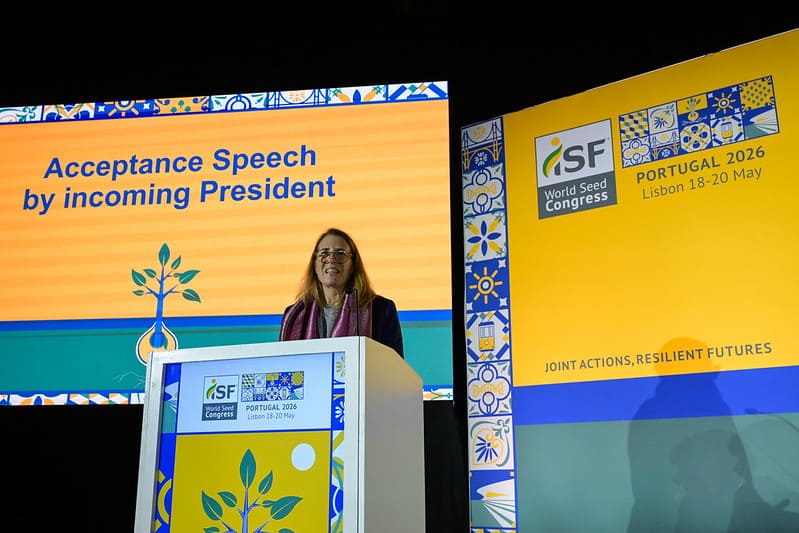
At its General Assembly, the International Seed Federation (ISF) elected Lorena Basso as its first female president in 102 years of history. Basso, president of Basso Semillas, a family-owned Argentine company with almost a century of experience, has spent more than two decades in the seed industry and serves on the ISF Board of Directors.
Fruit Today spoke with her in Lisbon during the World Seed Congress about the challenges facing the fruit and vegetable sector, the regulation of new technologies and her roadmap as head of the federation.
Fruit Today: Extensive crops such as wheat, maize and soy dominate the Congress. What is the specific situation for the fruit and vegetable sector?
Lorena Basso: In horticulture, the major challenge continues to be phytosanitary management. The entire fruit and vegetable sector is heavily affected by phytosanitary issues. The technologies discussed during the press conference on genome editing are not yet directly impacting the horticultural business, but they will. There are already specific developments in fruit and vegetables, such as a lettuce project in Argentina. However, these have not yet reached the commercial stage because companies have products ready but are not legally allowed to commercialise them.
FT: How does Argentina approach genome-editing regulation compared with Europe?
L.B.: Argentina was the first country to resolve this issue, around ten years ago. The system is binary and straightforward: is it a GMO (genetically modified organism) or is it not? If it is not, it follows the traditional registration process. If it is, it follows the GMO registration route. There is no third category, and that provides legal certainty.
Europe is currently debating an initial resolution that will soon move to Parliament. It proposes two separate categories, which differs from the Argentine model, but the direction is positive. Argentina’s experience is transferable. There is no need to reinvent everything if other countries have already solved the problem.
FT: Spain faces recurring issues with illegal seed use, particularly in citrus and potatoes. How do you view this from the ISF perspective?
L.B.: It is a difficult problem to solve without an international or at least supranational agreement because legislation is national and realities can vary completely from one country to another.
What I am certain about is that intellectual property must be respected. When it is respected, it generates economic returns for seed companies, creating a virtuous circle of investment, innovation and benefits for growers.
The industry invests between 10% and 30% of its turnover in R&D, but it needs a return on that investment. When a territory does not protect intellectual property, companies simply do not invest there.
FT: How is climate change affecting fruit and vegetable seed production?
L.B.: From a seed production perspective, we are adapting sowing dates and production locations.
The problem may arise from extreme rainfall or high temperatures. If a plant is flowering and experiences excessive heat, pollination fails and productivity is lost.
That is why we need sufficient stock, larger production areas or diversified production locations.
Every year, 2,000 productive hectares are lost worldwide, either due to urbanisation or because temperatures no longer allow seed production. The only solution is to make the remaining area much more productive, and that means innovation.
FT: What are your priorities as ISF President?
L.B.: I have two clear priorities. The first is gender. There are many women working in the industry, in research and in regulatory bodies, who still lack visibility.
Twenty per cent of the attendees at this Congress are women; we have never seen so many before. After 102 years, ISF now has both a female president and a female vice-president. That shows the sector is changing, but we need to continue broadening the base.
The more women enter companies, the larger the pool of future female leaders.
RELATED NEWS: Genome editing and global trade take centre stage at the World Seed Congress
The second priority is delivering tangible results: achieving much greater regulatory alignment between countries and implementing phytosanitary systems that allow seeds to move more efficiently.
My obsession is moving seeds. Seeds travel back and forth across borders, and for that to happen, countries need to be aligned.
FT: Is sustainability still a genuine priority for the sector, or has it lost momentum following the pandemic and geopolitical crises?
L.B.: My feeling is that pressure from the European Green Deal has eased somewhat.
However, I believe the answer lies somewhere in the middle: neither the radicalism of pure organic production nor the absence of sustainability criteria.
We need to think about an agricultural system that uses fewer and fewer resources because those resources will not always be available.
To achieve this, producing countries and importing countries must sit at the same table. We cannot build an agenda solely from the consumer side without considering where food will come from.
Ultimately, this goes beyond seeds. It is about feeding a world in which 700 million people still suffer from hunger.