








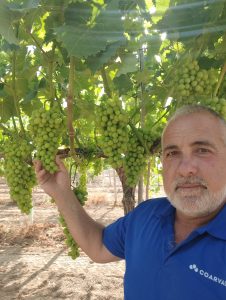
Sánchez defends “the unique value of a traditional grape with more than a century of history, whose main challenge is to increase the volume certified under the quality label.”
For the President of the Designation of Origin, seeds should not be regarded as a disadvantage, but rather as another characteristic of a product that has historically been part of consumers’ eating habits.
“We have eaten seeded grapes all our lives,” he recalls, adding that many people even chew the seeds because of their nutritional properties.
Two markets coexisting
The rise of seedless grapes has been evident in recent years, both in production and consumption, but this growth does not imply the disappearance of traditional grapes.
“At the D.O. Uva Embolsada del Vinalopó, we do not see ourselves as being in competition with seedless grapes,” he says.
In his view, they are parallel markets.
“Seedless grapes have gained momentum, particularly because they are more convenient to eat, but seeded grapes continue to enjoy a solid consumer base that values flavour, texture and tradition.”
In this respect, Sánchez points out that traditional seeded varieties generally offer a more intense organoleptic profile.
“They are tastier grapes, with greater sweetness and a firmer texture.”
Among the varieties covered by, or historically associated with, the production area are Victoria, Doña María, Ideal, Dominga, Napoleón, Red Globe and Aledo.
Aledo, the flagship variety at the end of the season
Within the production calendar, Aledo plays a particularly important role. It is the variety that remains available until the end of the campaign, allowing the region to maintain its presence on the market during the final months of the year.
According to Sánchez, when November and December arrive, Aledo becomes one of Spain’s benchmark fresh grape varieties.
The major challenge: increasing certified volumes
Beyond the debate between seeded and seedless grapes, Sánchez identifies a major internal challenge for the Designation of Origin: increasing the volume of grapes marketed under its certification.
According to him, between 30 and 35 million kilograms of bagged grapes are produced in the region, yet only five to six million kilograms are ultimately marketed with the D.O. certification.
He stresses that the remaining grapes are neither lost nor removed from the market; they are simply sold without certification. The difference is that they are not identified as products protected by the Designation of Origin.
“All the grapes are sold, but they are not sold as certified products and therefore lose the added value that a Designation of Origin certification provides.”
RELATED NEWS: Grapes break the calendar and redraw the global map
One of the issues that concerns the organisation most is product identification at the point of sale.
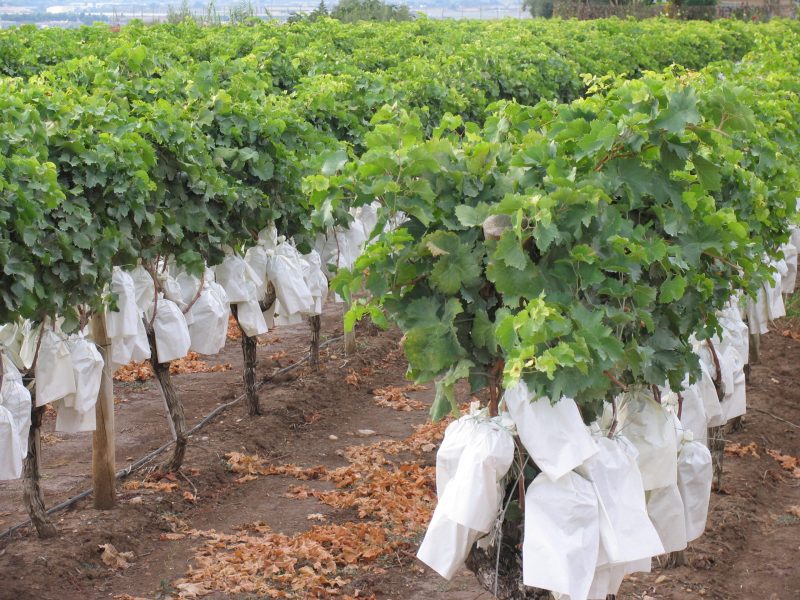
Bagged grapes take their name from the cultivation technique itself: each bunch is protected on the vine with a paper bag, a method that helps preserve fruit quality. However, that paper bag does not always reach the final consumer.
Certified grapes are handled, cleaned, graded and packed at the packhouse. As a result, they must be identified through the Designation of Origin’s own distinguishing elements, such as quality seals, neck tags or dividers.
“We need to identify the product properly so that consumers can easily recognise it,” Sánchez says.
In his opinion, the Designation of Origin must strengthen its visibility while encouraging more operators to market their premium brands under the D.O. quality seal.