






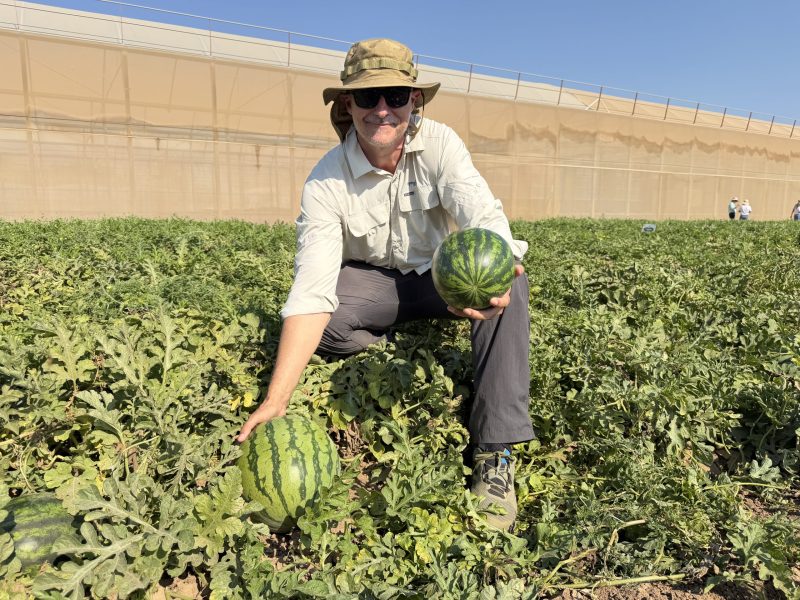
During the first week of July, the Region of Murcia hosted the traditional open days organised by seed companies, becoming the centre of varietal innovation in melon and watermelon for several days during the well-known ‘Melon & Watermelon Innovation Days’. In this context, smaller sizes, internal quality and convenience formats emerged as the common themes across most companies.
Proexport highlighted the value of the event for a sector whose exports are approaching €960 million. Throughout the week, seed companies including Bayer Seminis, Enza Zaden, BASF | Nunhems, Rijk Zwaan, Syngenta, KWS, Semillas Fitó, Cora Seeds, HM.Clause and Ramiro Arnedo opened their trial fields to growers, supermarket technicians, importers and breeders from around the world.
Fernando Gómez, Managing Director of Proexport, underlined the event’s unique nature: it takes place at the height of the harvesting season and enables visitors to examine the new varieties in situ and schedule meetings with cooperatives and packing facilities in the Region.
The backdrop is the positive performance of the 2025 season. According to Customs figures, watermelon and melon exports approached €960 million, 18.5% above the average for the previous five years. Murcia leads melon exports, with €155.2 million, up 3.56%, and ranks second for watermelon behind Andalusia, with €121 million, up 7%.
BASF | Nunhems: mini and midi sizes set the pace
BASF | Nunhems held its Business Event For Experts at the Nunhems Spain trial farm in La Palma, Cartagena, from 30 June to 2 July. Juan Pedro Pérez Abellán, Regional Crop Lead for Watermelon and Melon EMEA, explained that the company structures its portfolio around four pillars: quality and reliability, productivity, versatility — under the slogan ‘Versatility That Performs’ — and innovation.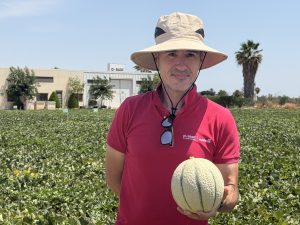
In watermelon, the trend towards smaller sizes shaped the latest launches: Mini 108, a black seedless watermelon, and NUN 32408 WMW, a striped seedless variety described as “the travelling watermelon” due to its adaptability to different growing areas. Mercedes Fernández Lozano, Sales Manager, highlighted the company’s objective of covering the full size range, from one kilo to 8–10 kilos, without compromising on flavour.
In melon, José Ramón Naranjo presented the new genetic line in piel de sapo with Izalco and Aralco. In Charentais, Aragorn continues to consolidate its position alongside the new NUN 14012. Thebes and Delphes confirmed their strong performance. SunUp and Galkia remain key references in the speciality segment, now joined by NUN 67054 MEM.
In terms of innovation, the company is also working on a prototype orange-fleshed piel de sapo melon and continues to invest in the Honey Dew segment, with Mayan 510 and Mayan 443 as commercial references aimed at younger consumers.
Bayer Seminis, ‘Ready to Enjoy’
Under the slogan ‘Ready to Enjoy’, Bayer Seminis opened its Melon & Watermelon Week in Villadolores, Cartagena, on 29 June. José Guirado, Market Development Manager for Melon and Watermelon Iberia, summed up the change in consumer profile with a striking observation: “a 10-kilo watermelon no longer fits in any fridge”.
The major melon innovation was SVMP6001, Bayer’s first piel de sapo variety in several years, with a branded size of around 3 kg and an unprecedented resistance package for this type. The company also showcased Orange Candy SVMA6731 and developments in the Cyro Line Galia range — Galves, Albizu and Gallager — as well as Cantaloup varieties Sugarsun and Acapella, and the yellow melon Chester line, comprising Chester, Rochester and Manchester.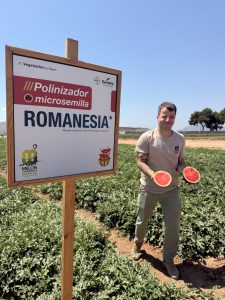
In watermelon, the main innovation was Romanesia, a micro-seeded pollinator joining Polinesia. For the fresh-cut and ready-to-eat segment, Bayer presented Shoreline and Durlinda, the latter already established thanks to its firmness and low water release after cutting.
The company also devoted a section to convenience, highlighting developments carried out with Almería-based Unica in cut formats and prepared dishes, a segment gaining ground on supermarket shelves.
Rijk Zwaan presents Galuna RZ and strengthens Candy Ball
Rijk Zwaan held its Global Melon & Watermelon Event at its La Palma Trial Centre. Bernardo Cuenca, Global Melon and Watermelon Coordinator, presented Galuna RZ, a new Galia melon concept that changes colour from green to yellow as a visual indicator of optimum sugar levels, ranging from 13 to 18 degrees Brix.
The concept comprises three staggered references: Galuna Quartz RZ, Galuna Lithium RZ and Galuna Hiron RZ. He also announced new resistance to powdery mildew races 6 and 7 in the company’s Defense line, with plans to extend this protection to other melon types.
In watermelon, the offer was structured by size. Meanwhile, in Candy Ball, at 1–2 kg, the company reinforced Vaiana RZ. In Sandissima, at 2–4 kg, the innovation was Cherrinho RZ, featuring “nano seeds”. In the triploid segment, at 4–8 kg, it presented Ganímedes RZ, with dark green skin, excellent flavour and uniform sizing, and Winslet RZ, a Tiger type combining yield with good suitability for cutting and processing.
Syngenta sets its sights on Castilla-La Mancha
Syngenta, leader in the early piel de sapo segment with Bobal and Graciano, has added Requena, MP7758, this season. The variety is resistant to New Delhi virus, powdery mildew and aphids and is primarily aimed at the Portuguese market.
Víctor García, Portfolio Lead Cucurbits Iberia, previewed a “new generation” of branded-size piel de sapo melons currently in the pre-commercial phase, with which the company aims to regain the leadership it once held with Sancho in the mid-season cycle in Castilla-La Mancha.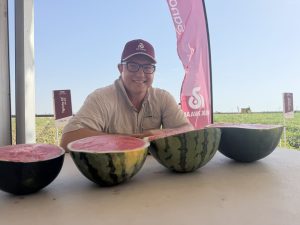
In Charentais, its latest addition is Bisantin, MC27827. In watermelon, the company is launching a new line of mini micro-seeded pollinators, beginning with WDMO23-7293, which stands out for its pollination capacity and for maturing at the same time as Red Jasper and Jamaica.
Meanwhile white seedless watermelon, Ágata continues to increase sales in Castilla-La Mancha, Murcia, Seville and Portugal, thanks to its resilience and good field holding capacity.
Enza Zaden puts watermelon and convenience centre stage
Enza Zaden made watermelon the centrepiece of its Melon & Watermelon House Fair 2026 at its Research Centre in El Albujón, Murcia. The company entered the crop in 2017 and now holds close to a 27% market share in the United States.
It presented Cracker Jack, Big Jack and the yellow-fleshed Sunstone, as well as the mini black seedless Tyrion and pre-commercial materials in striped and Tiger types.
In melon, the company is working on Honey Dew varieties and a yellow melon with ‘dino-type’ spots, currently in the pre-commercial phase.
An in-house study involving more than 3,000 European consumers found that 85% already purchase ready-to-eat products. Enza Zaden is responding to this trend with firmer fruit that does not compromise on flavour, avoiding what it describes as “ultra-firm watermelons”.
Fitó showcases its open-air innovation
Semillas Fitó held its Water & Melon Show at its Lobosillo trial farm and Piscina Garden, presenting its most complete portfolio for Iberia.
In yellow melon, the main innovation was Bullaque, formerly MH230567, while Liverpool, GLV230884, stood out in Galia. In piel de sapo, alongside Arroyo, Montiel and Lindero, the company presented two pre-commercial varieties and Kalimero, its first commercial mini piel de sapo melon, weighing under two kilos.
It also showcased the Cantaloup CLV213028 and its white melon range, including Brinches, Pias and Ervidel.
In watermelon, Raquel Gómez, Area Manager Iberia, highlighted Taylor together with its pollinator Pilar, described as “a versatile all-rounder” suitable from early transplants through to late plantings in Castilla-La Mancha. The company also presented the triploid Rhiana, a complete pollinator range comprising Leiva, Raquel and Amaral, and the already well-established specialities Waikiki and Little Planet.
Dolcir, HM.CLAUSE’s commitment to Murcia
For the Almería region, HM.CLAUSE presented Vendaval F1, a Galia melon with excellent netting, flavour and a small internal cavity, and Cormorán F1, a Cantaloup with a crunchy texture, high Brix levels and strong post-harvest performance.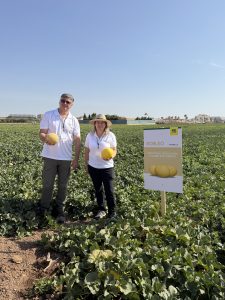
Both varieties include resistance to powdery mildew and aphids and offer uniform commercial sizing, highly valued by the export market thanks to their intense aroma and firm texture.
For Murcia, the company highlighted Dolcir, a smooth-skinned Liscio-type melon with orange flesh and a delicate, sweet flavour, developed for export. The type is already successful in Italy and offers improved shelf life together with a flavour that attracted considerable attention among those attending the field days.
Cora Seeds holds its first demonstration field
Cora Seeds Ibérica held its first watermelon open days in Spain in Pulpí, Almería, from 29 June to 3 July, attended by sector professionals representing more than 4,000 hectares of production.
Highlights included Samba F1, an early-cycle Sugar Baby type with high tolerance to hollow heart, and Selvaggia F1, a mid-cycle Jubilee seedless variety with excellent flavour.
The company also previewed CRX 100439, a slightly oval Sugar Baby type for the mid cycle, and presented Mustang F1, a Crimson Sweet type, alongside its micro-seeded range comprising Gioiosa F1, Nikita F1, Nikas F1 and Pepita F1.
“After many trials, we have managed to complete the circle with all size types and excellent quality,” said Francisco Solera, the company’s Director.
KWS presents its future in melon and watermelon
KWS Vegetables held its first Melon & Watermelon PopUp at its station in Miranda, Murcia, an event designed to build relationships with the sector ahead of the launch of its first commercial varieties, planned for next year.
Although its current presence is still limited — with two commercial white melon varieties in Portugal — the company is developing several materials in Galia, Honey Dew and Cantaloup, as well as a commercial micro-seeded watermelon variety expected to be launched for the next season. The material has been well received by growers who have already trialled it.
Ramiro Arnedo focuses on flavour and resistance
Ramiro Arnedo held its Melon Week from 30 June to 3 July at its new Los Médicos trial farm in Campo de Cartagena, focusing on flavour, resistance and yield.
RELATED NEWS: Spanish watermelon and melon season starts with firm prices
Javier Nicolás, Melon Product Manager, presented two pre-commercial varieties: AR-30335 F1, a Galia with high resistance to Fusarium and intermediate resistance to aphids and powdery mildew, and AR-30340 F1, a Gourmet dinosaur-egg type with an unusually broad resistance package for this category.
The company also showcased developments in Branco, piel de sapo and late yellow melon, together with Hawái F1, its reference in early yellow melon.