







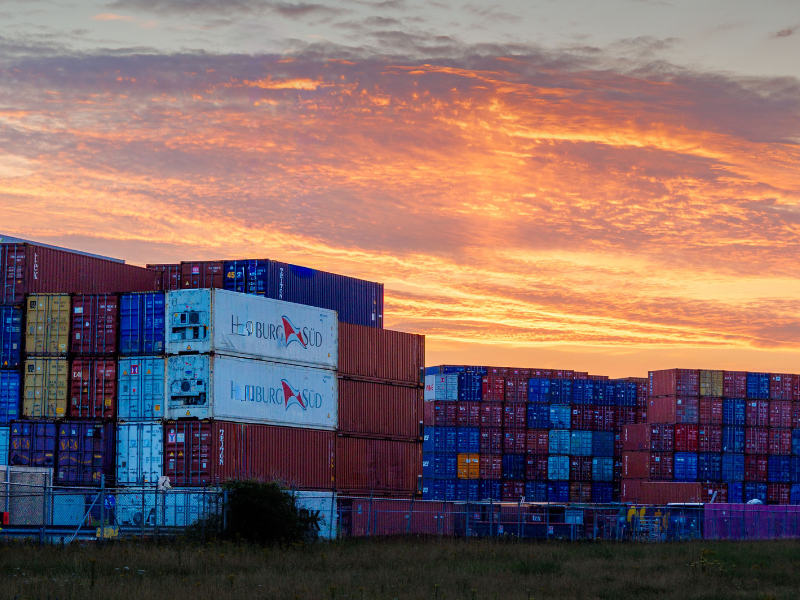
Rotterdam World Gateway (RWG) has announced a €500 million investment in a new expansion of its container terminal at Maasvlakte 2, in the Port of Rotterdam. The project includes the construction of a fourth deep-sea berth and a significant increase in the automation and electrification of terminal operations.
The investment is relevant for international trade, including the agri-food sector, as Rotterdam is currently Europe’s largest port and one of the main gateways for goods that are later distributed across continental markets.
This project was developed in consultation with RWG’s shareholders: DP World, CMA CGM, Ocean Network Express (ONE) and HMM. It will allow the terminal to use the full quay capacity previously allocated by the Port of Rotterdam Authority.
The expansion will add five new ship-to-shore (STS) cranes for container vessels, together with 22 Automated Stacking Cranes (ASC) distributed across 11 storage modules, and 24 Automated Guided Vehicles (AGV) for moving containers within the terminal.
This project deepens a strategy that Rotterdam has been developing for several years: increasing terminal capacity through highly automated infrastructure while moving towards lower-emission operations. The Port Authority has stressed that the Maasvlakte terminal expansions are aimed at automated and carbon-neutral operations.
A fourth berth for the world’s largest container ships
One of the main components of the investment will be a fourth deep-sea berth, designed to receive the largest container ships currently operating on international routes.
RWG currently has two deep-sea berths, with a combined quay length of around 1,150 metres and a depth of 20 metres, as well as an approximately 550-metre quay for feeder and barge operations.
The terminal’s current annual capacity is around 2.35 million TEU.
The announced expansion will be developed progressively and in parallel with a previous enlargement. In 2023, the Port of Rotterdam Authority announced a project covering approximately 45 hectares and 920 additional metres of quay, with the capacity to gradually add another 1.8 million TEU to RWG.
The new infrastructure now announced is expected to become commercially operational before 2030, bringing the terminal’s total capacity to around 5 million TEU.
With this new phase, cumulative investment in the development of Rotterdam World Gateway would reach approximately €2 billion.
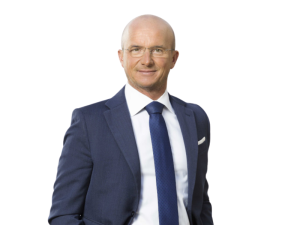
RWG CEO: “An investment in the future”
Ronald Lugthart, CEO and chairman of the board of Rotterdam World Gateway, said this stage represents the culmination of the terminal’s original concept.
“This final phase marks a special moment in the development of RWG. What began as an ambitious plan on a completely new site at Maasvlakte 2 is now moving towards the final phase of the terminal as it was originally conceived,” said Lugthart.
He added that the investment goes beyond the physical expansion of infrastructure.
“The final phase will not only reinforce RWG’s continuity, but also improve Rotterdam’s competitive position as the most important gateway to Europe. This makes it more than an investment in a terminal; it is an investment in the future of Port 2.0, the region and Rotterdam’s international position. We will continue to deliver on our promise of ‘seamless access to Europe’,” he said.
BoxBay: storing containers like a vertical warehouse
One of the most innovative technological components of the project could be the incorporation of BoxBay, an automated vertical container storage system.
RWG will evaluate its use for handling around 30,000 TEU in empty containers.
Unlike a conventional yard, where containers are stacked on top of each other and several units often need to be moved to access a specific container, BoxBay uses a high-bay storage structure that provides individual access to each container.
According to DP World, the concept works in a similar way to a vertical storage building, allowing containers to be stored up to 11 levels high and achieving capacity comparable to that of a conventional terminal while using around one third of the space.
The technology was first tested in Jebel Ali, Dubai, where DP World completed full-scale trials with more than 63,000 container moves, reporting results above expectations in terms of speed and energy efficiency.
The company is also moving ahead with the implementation of BoxBay at London Gateway, in the United Kingdom, for the storage of empty containers.
More capacity for Europe’s logistics needs
The RWG expansion comes as Rotterdam prepares its infrastructure for the projected growth in container traffic.
The Port Authority has stated that Rotterdam is the only major port in north-west Europe that still has room for substantial expansion, with the potential to add up to 8 million TEU per year across the port complex.
Parallel investments are also under way at terminals such as APM Terminals Maasvlakte II and Euromax, forming part of a broader modernisation process for Rotterdam’s container infrastructure.
Although RWG’s investment is focused on general container handling, the strengthening of Rotterdam also has implications for agri-food supply chains that use the port as a gateway to the continent.
Rotterdam has infrastructure specifically linked to agri-food and refrigerated cargo. In 2026, the Port Authority also announced the development of 38 hectares of new logistics infrastructure at Rotterdam Food Hub, designed for the storage and transhipment of refrigerated and frozen agri-food products.
For exporting countries in the Southern Hemisphere, including Chile, Peru, South Africa and other major international suppliers of fruit and food products, increased European port capacity is particularly relevant due to the need for fast and predictable logistics chains.
The combination of greater berth capacity, automated container handling, electrification and intelligent storage systems is designed to reduce bottlenecks and increase port productivity.
For perishable products, where even a few additional hours at the port can affect condition, post-harvest life and arrival quality, these investments also have a strategic dimension.
Rotterdam is therefore moving towards a model in which physical port expansion goes hand in hand with automation, digitalisation and electrification, as it seeks to maintain its position as one of the world’s major logistics hubs and the leading maritime gateway to the European market.