






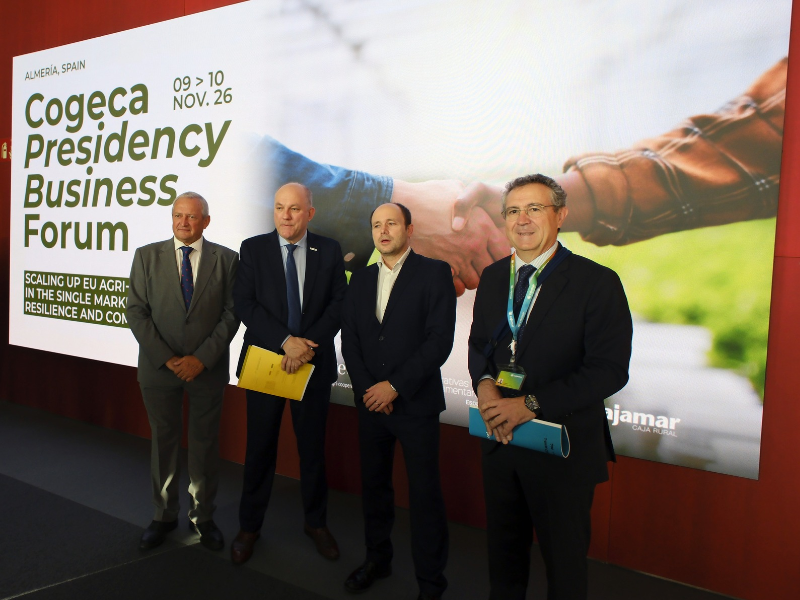
Europe’s agri-food cooperative sector is calling for greater investment, innovation and business integration to strengthen competitiveness and ensure a stronger Single Market. These were among the main conclusions of the COGECA Presidency Business Forum, held on 9 and 10 November in Almería with representatives from cooperative organisations and businesses from across the European Union.
Organised by COGECA, Cooperativas Agro-alimentarias de España and Cajamar, the event was held under the theme “Driving the growth of EU agri-food cooperatives in the Single Market. Identity, resilience and competitiveness.”
Almería provided a showcase for one of Europe’s most competitive and innovative agri-food models, characterised by cooperation between producers, an international market focus, technological adoption and efforts to improve resource efficiency.
Greater scale to compete in Europe
During the forum, Ángel Villafranca, president of Cooperativas Agro-alimentarias de España, called for greater integration among European cooperatives and the creation of alliances, including between businesses competing in the same markets.
“We have to look for opportunities together and build alliances. Cooperatives need to gain scale, make the most of our complementarities and strengthen our position in the European Single Market,” he said.
Villafranca argued that the cooperative model is particularly well placed to address current challenges by combining business activity with commitment to members, employment creation and rural development.
Against this backdrop, he called for European policies that recognise the strategic importance of food production and enable greater investment in cooperative industry, innovation and digitalisation.
The president of Cooperativas Agro-alimentarias de España also warned that decisions on the future Common Agricultural Policy and the EU budget should not create competitive disparities between Member States. “We need more integration, not less,” he stressed.
He also called for a level playing field for European producers, highlighting Almería as an example of competitive agriculture operating under a demanding regulatory framework. In this regard, he advocated equivalent standards for imports, together with further investment in infrastructure and water efficiency.
Cooperatives are key to maintaining Europe’s own agri-food fabric
Eduardo Baamonde, president of Cajamar, highlighted the strategic importance of the agri-food sector because of its economic, social and environmental contribution.
Baamonde pointed to the highly diverse structure of Spanish agriculture: 12% of farms account for 75% of the value of Final Agricultural Production, while 68% generate gross agricultural income of €25,000 a year.
In response to this reality, he called for a strong commitment to common policies supporting investment, particularly measures aimed at improving productivity and competitiveness and accelerating the adoption of new technologies.
RELATED NEWS: Copa-Cogeca call for urgent measures ahead of the EU Fertilisers Action Plan
Cooperatives, in his view, play a fundamental role by providing services that enable farmers and livestock producers to maintain their businesses and undertake investments that would be more difficult to make individually.
“Cooperatives are proving essential if we want to maintain our own agri-food fabric within the European Union,” Baamonde said, reaffirming Cajamar’s commitment to the sector and to Europe.
Greater collective strength to address future challenges
Lennart Nilsson, president of COGECA, emphasised the ability of cooperatives to create greater collective strength among farmers and livestock producers.
Sharing resources, investing collectively and achieving greater scale enables cooperatives to better address challenges related to strategic autonomy, competitiveness, resilience and digitalisation, he said.
Nilsson called on policymakers to establish a European policy and investment framework that allows cooperatives to innovate, grow and strengthen their market position.
“Stronger agri-food cooperatives mean stronger farmers and livestock producers, more competitive and resilient agri-food value chains, more dynamic rural areas and a Europe that creates opportunities,” he said.
22,000 cooperatives across the EU
The scale of the cooperative movement is reflected in COGECA’s figures. The organisation represents around 22,000 European agri-food cooperatives, which collectively produce more than half of the food consumed in Europe, generate more than €300 billion in turnover and provide more than 600,000 direct jobs.
In Spain, the agri-food cooperative sector comprises 3,669 cooperatives and nearly 1.2 million farmer and livestock producer members, generating €44.77 billion in turnover and more than 119,000 direct jobs.
Their activity represents approximately 68% of the value of Spain’s Final Agricultural Production and 25% of national food industry sales.
Beyond their economic weight, cooperatives also play an important role in strengthening rural territories, helping producers to concentrate supply, access new markets, improve their bargaining power and jointly undertake investments in processing, technology and marketing.
Almería showcases cooperative innovation
The Business Forum combined analysis sessions with technical visits showcasing examples of innovation and cooperative organisation in Almería.
Participants visited the Cajamar Las Palmerillas Experimental Station in El Ejido and the Vicasol cooperative, two examples of the technological and business development of the Almería agri-food sector.
The main session, held at the Almería Science and Technology Park (PITA), brought together European cooperative representatives to discuss growth opportunities within the Single Market, business integration and the strategies needed to strengthen competitiveness without compromising the identity and values of the cooperative model.
The event highlighted the need to achieve greater scale, strengthen alliances and drive investment and innovation so that cooperatives can respond to an increasingly competitive European environment while contributing to the preservation of Europe’s own agri-food fabric and dynamic rural communities.