








“I said it and I stand by it: by the middle of the 21st century, there will be no kitchens.” Statements made by Mercadona’s chairman at the beginning of the year once again triggered heated debate between advocates of traditional cooking and consumers less attached to the stove. The discussion has gone far beyond ordinary shoppers. Food critics, chefs and other retail stakeholders have joined a public debate comparable to the perennial Spanish argument over whether potato omelette should contain onion.
Among those who weighed in was Ricardo Álvarez, CEO of DIA Spain, who insisted that “kitchens will never disappear in Spain”, although he added: “…but they are increasingly used for leisure or recreational purposes”.
That final point echoes one of the most frequently repeated arguments in the food and gastronomy sector in recent years. In the report ‘Is the kitchen dead?’ by global financial giant UBS, market analysts argue that advances in food technology and the optimisation of industrial costs will eventually make cooking from scratch financially irrational for households. They therefore foresee an imminent scenario in which routine food preparation disappears from the home, turning cooking into a purely recreational choice or a weekend hobby.
In the world of gastronomy, critic José Carlos Capel said in an interview on Cadena SER that the disappearance of the domestic kitchen is already visible in Spain’s property market, where homes are beginning to be designed with little more than a microwave and a small dishwasher. In Capel’s view, this reflects a systemic lack of time and an irreversible decline in the role of traditional cooking, pushing consumers towards so-called ‘Mercaurantes’.
Mercaurantes, a global phenomenon
Far from being a local anomaly, the Spanish critic warned that the future of the sector lies in large food retail spaces and ready-to-eat meals, a formula of vast communal eating areas already widespread in countries such as China and established for years in the United States. Closer to home, the United Kingdom and Italy offer a wide range of prepared food options on supermarket shelves.
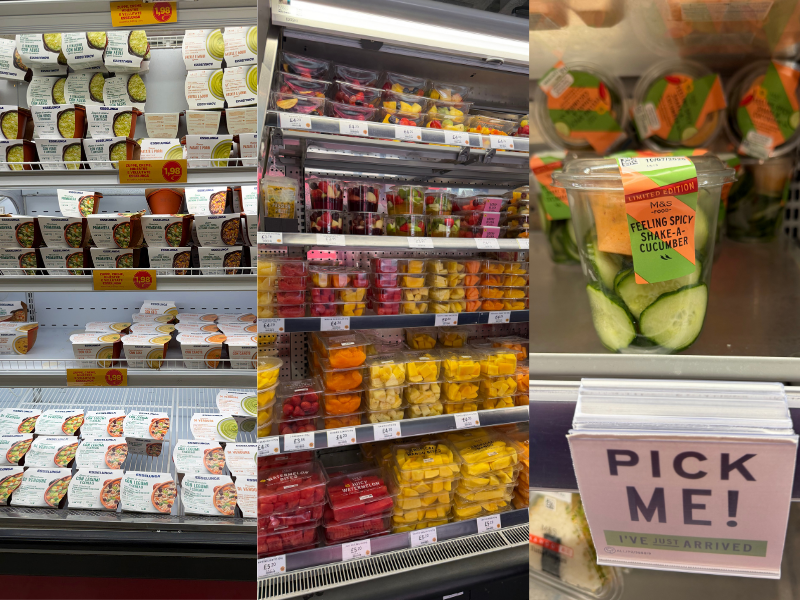
This debate over the end of the stove has a very concrete expression at retail level: the unstoppable rise of fresh-cut and ready-to-eat fruit and vegetables.
While Mercadona generated €3 billion in sales from prepared foods in Spain and Portugal in 2025—more than McDonald’s and Burger King combined in the Spanish market—the fruit and vegetable processing segment is growing at its own pace, driven by the same convenience trend but shaped by very different dynamics and pressures.
Processed fruit and vegetables: uneven growth
According to Circana, between February 2025 and January 2026, fresh-cut and ready-to-eat fruit and vegetables reached 131,258 tonnes and €942.7 million in Spanish retail, up 5.9% in volume and 9.7% in value.
The average price rose by 3.6% to €7.18/kg. Fresh-cut products account for the bulk of the business, with 117,629 tonnes and €887.58 million, representing increases of 4.3% in volume and 9.1% in value. Ready-to-eat products, though still smaller, are the main growth engine, at 12,208 tonnes, up 24.1%, and €40.1 million, up 26.5%.
Within fresh-cut, prepared vegetables account for 48% of volume and grew by 6.2%, while salads represent 40.4% and increased by 4.4%, with complete meal salads rising by 9.8%, according to Nielsen.
Cut fruit, by contrast, lost around 3% in volume despite gaining 7% in value, held back by the wide availability of whole fresh fruit, price sensitivity and a still-weak perception of added value.
Nevertheless, the sector is aware of the changing habits of the ‘TikTok generation’ and believes this could transform supermarket shelves. Several seed companies told Fruit Today that “one of Spain’s leading retailers” expects 25% of the fruit in its department to be sold cut and processed within five years. Watermelon is one of the fastest-growing products in this segment.
The importance of processed fruit and vegetables is now such that some supermarket chains have separate purchasing managers for fresh fruit and vegetables and processed produce, according to sources consulted by Fruit Today.
Convenience is no longer an added extra
The concept that best captures this transformation is ‘foodvenience’: the convergence of food and convenience.
Ready-to-eat food in supermarkets has grown by 55% since 2022, and 78% of this consumption takes place at home. Worldpanel by Numerator confirms the trend: in 2025, the average time spent cooking fell to 24.8 minutes, while one-dish meals accounted for 71.3% of evening meals at home, compared with 68% in 2020.
For fresh-cut and ready-to-eat fruit and vegetables, this opens up a clear opportunity: recognisable, plant-based products that are easy to prepare without compromising on health. Although 77.1% of consumers say they want to follow a healthy diet, that attribute alone is no longer enough to justify the purchase.
RELATED NEWS: The new stars of fresh-cut and ready-to-eat produce
Innovation is therefore moving from the basic salad to the complete meal: recipes with protein, grains and sauces; microwave- and air-fryer-friendly formats; and technologies such as High Pressure Processing (HPP), used by companies including Avomix and Frutas Montosa to extend the shelf life of their guacamole.
Surexport, meanwhile, is introducing resealable closures for family-sized cut-fruit packs.
The ready-to-eat category is also expanding into individual portions of pulses and plant-based cuisine, and even into textured dishes for people with dysphagia, recognised at the Horeca Awards 2026.
Retail calls the shots: private label and quick commerce
Private label dominates the category beyond dispute, with an 81.2% share by volume and 74.6% by value, posting growth of 6.6% and 11.5% respectively, ahead of manufacturer brands.
This position of strength makes the retailer the leading prescriber of innovation, range and price, while allowing it to demand volume, food safety, consistency and sufficient shelf life from suppliers.
As Carrefour and Just Eat Spain explained at the AECOC Fruit and Vegetable Congress, in 2025 the chain sold 1.7 million units of fruit and vegetables through delivery.
One in seven quick-commerce orders included fresh or fruit and vegetable products, with an average basket value 22% higher among these customers, 70% of whom were under 35.
Costs, cold chain and investment
The category is facing continued increases in energy, labour, raw materials, transport and refrigeration costs, compounded by weather volatility and staff shortages.
The sector has passed part of these increases on to the final price, but an increasingly rational consumer limits the scope to do so: 67.9% always compare prices between brands.
This gap between volume and value growth sums up the unresolved equation: adding value to the product without losing the shopper.
In this context, the cold chain is inseparable from the value proposition. A temperature break not only shortens commercial shelf life, but also compromises safety, flavour and waste levels.
Despite margin pressure, investment continues, while the initiative by AECOC and the Mediterranean Corridor Office to promote rail freight points towards a future route for decarbonising logistics.
It is within this balance—between Roig’s prediction and the reality of the shopping basket—that much of the future of fresh-cut and ready-to-eat fruit and vegetables will be decided: growing without becoming unaffordable.