







With the Spanish season having just begun, what grape crop volumes are expected?
Volumes are expected to be similar to last year, although quality is considerably higher this season, and this may help to increase the volume slightly. We are very pleased with the situation.
What are your main production areas?
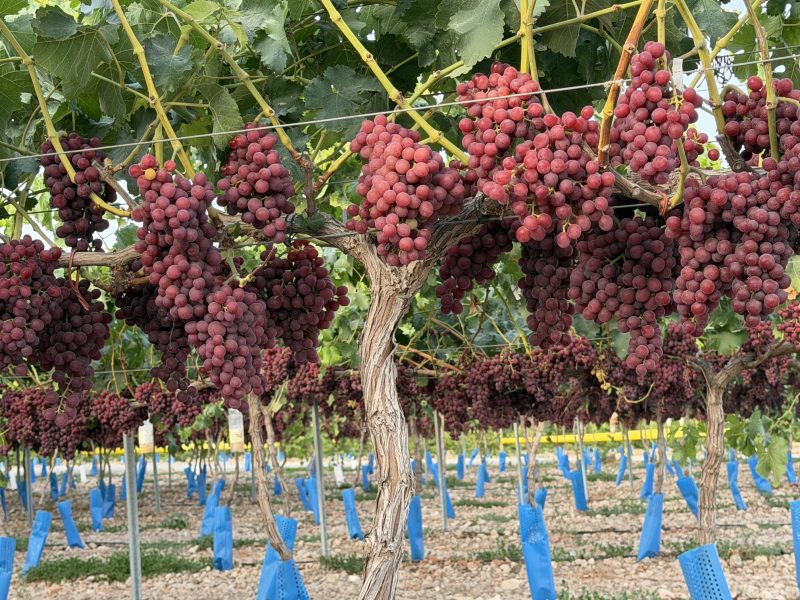
Our grape fields are located in Murcia, practically all within a 25-kilometre radius of the packing facility. We also grow berries in Huelva, while in Lleida we work with associated growers with whom we have built up a long-standing relationship. As an exception, we have a production site in Granada at an altitude of 900 metres, which is remarkable. In addition, other companies within the group have production in the Southern Hemisphere, complementing our offer.
In terms of sales, what are your main destination markets?
We work with practically every market in Europe, without exception. Outside Europe, we are present in South Africa and Canada.
What are the main grape varieties you offer your customers?
In Murcia, we have a major breeder, ITUM, in which we are shareholders, so part of our production is based on varieties developed right here in Murcia. We also work with Bloom Fresh varieties, a company that has very recently “become Murcian”. In fact, it is now our neighbour and will be opening its facilities very soon.
Murcia has a highly favourable climate for grapes due to its low humidity, and this contributes significantly to quality.
Do you have any specialisation within the category, such as strawberry-flavoured or Champagne grapes?
As a speciality, we offer flavoured grapes in all three colours: white grapes with a candyfloss flavour, red grapes with a strawberry flavour and black grapes with a confectionery flavour. We also have a white grape with the flavour of peladilla, a traditional sugared almond from our town, Abarán.
Broadly speaking, what are the main challenges facing Murcian grapes?
The main challenge we currently face is competition from third countries. In recent years, the start of the season has been commercially affected by Egyptian grapes on European markets, and this represents a significant threat.
This is not only because of their cost advantage and the social conditions under which they operate, which are vastly different, but also because of their phytosanitary advantage. They have access to crop protection tools whose use is prohibited in Europe, giving them a major competitive edge.
Our greatest challenge is therefore to demonstrate that our grapes, European grapes, have their place on supermarket shelves throughout Europe under conditions that allow the sector to move forward. Our grapes are produced here in Europe, geared towards European consumers and grown under the conditions they demand. This approach is very different from that of third countries, which will always sell to the highest bidder.
We have always defended our market window and we are not going to give up. We believe in our product, which is cleaner and safer than others, and we believe in the impeccable service we provide, something others cannot match.
We can reach Central Europe in three days, or even in two with two drivers, and this service cannot be equalled, as it guarantees a level of freshness that other countries cannot offer. I would not trade freshness in grapes for lower prices. Consumers notice the difference in the end, and sales suffer.
Grapes are one of the few fruits whose consumption has increased. Why do you think this is?
There is clearly a before and after with seedless grapes. I remember when my daughters were young and I brought grapes home, the first question was: “Dad, do they have seeds?”
These grapes have become an appealing snack at any time of day and for any occasion because they are so easy to eat. There has also been a major leap forward in flavour. Today’s grapes taste very good, even without taking into account the flavoured specialities, which are also helping to increase consumption.
It is much healthier for a child if their mother buys them grape “sweets” rather than confectionery sweets, and ultimately we are talking about health.
RELATED NEWS: Grapes break the calendar and redraw the global map
Grapes are also available 12 months of the year, and this consistency of supply helps to increase consumption. In our particular case, we complement our grape volumes with our own production from other companies within the group in Peru, in the north in Piura and Chepén, and in the south in Ica, as well as in South Africa.
We are also trialling varieties from different breeders in Brazil for the near future. Our objective is to offer a complete calendar while maintaining the same level of quality 12 months of the year across all our origins.
Have you made any recent investments in facilities and machinery?
It is important to emphasise that grapes involve 100% manual work, which is where the competitive advantage of third countries that I mentioned earlier comes into play.
In recent years, we have upgraded our entire grape packing facility. Obsolete machinery has been removed and replaced with individual workstations featuring the latest weighing and control technologies.
The main investment has been in our employees. We have air-conditioned the facilities to provide more comfortable working conditions in line with the 21st century. Part of the season takes place in summer, with the high temperatures typical of that time of year.
This is also why we have chosen not to handle the grapes in the field. Apart from the risk of exposing workers to high temperatures, it is not the best option from a hygiene perspective either, and we are talking about food.