








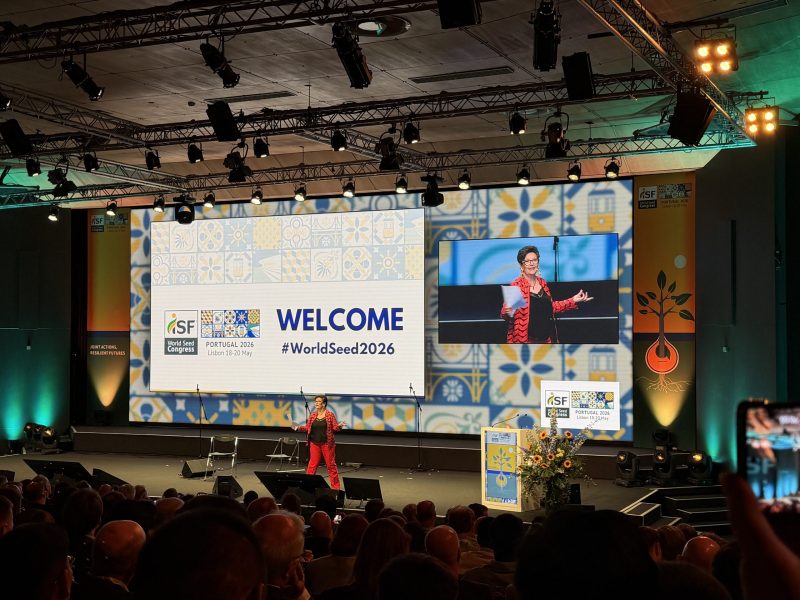
Lisbon hosted the world’s largest international seed industry gathering in May. The 2026 World Seed Congress, organised by the International Seed Federation (ISF) together with the Portuguese association ANSEME, brought together more than 1,700 delegates from over 75 countries at the Lisbon Congress Centre to discuss the major challenges shaping global seed production and trade: the regulation of new genomic techniques, regulatory alignment between markets, food security and supply chain sustainability.
A sector under pressure, with innovation as the driving force
The congress took place at a time of significant pressure on global agri-food systems. Geopolitical disruptions, climate change impacts and fragmented regulatory barriers across regions are redefining how seed moves around the world and how risk is distributed throughout the value chain.
With a seed market estimated at $90 billion and annual exports reaching 7.2 million metric tonnes, the industry represents a critical link in ensuring quality harvests and food security worldwide. Seed companies invest between 15% and 30% of their turnover in research and development, a proportion higher than in any other agricultural sector.
Genome editing at the heart of the debate
One of the central topics of this year’s programme was the regulation of genome editing, a technology that already has products on the market, such as high-GABA tomatoes in Japan and high-oleic soybeans in the United States, but which continues to face highly diverse regulatory frameworks.
Thirty-two countries have established specific regulations for genome editing, generally following one of two approaches: treating these products as GMOs while applying simplified procedures, or excluding them from the GMO category provided that the final product contains no foreign DNA.
Europe is moving in this direction through the New Genomic Techniques (NGT) Regulation, whose first-reading position has now been formally adopted by EU Member States.
During discussions held on the opening day, participants stressed that the lack of regulatory harmonisation between regions remains the main obstacle preventing varietal innovation from reaching growers more quickly.
Debates focused on how to build bridges between different regulatory frameworks without forcing any region to abandon its own model, and on how trade can continue to operate confidently under such circumstances.
Participants also highlighted China’s rapid expansion from 60 hectares to 2.5 million hectares of GMO varieties in just four years, as well as India’s recent launch of two genetically modified varieties developed to address specific health-related challenges. Both examples illustrate how technological adoption is accelerating in major producing countries, adding pressure to regulatory discussions in Europe and other importing markets.
International trade: between efficiency and uncertainty
Another key theme of the congress was the future of international seed trade.
During the event, ISF published a statement warning against the risks of imposing national production requirements, arguing that such measures contradict World Trade Organization principles and could lead to supply shortages and unfair advantages for certain countries.
Developing a commercial variety is inherently a global process: breeding can take up to eight years, followed by one to three years of production and distribution, with each stage often carried out in different countries according to climatic, technical and logistical criteria.
RELATED NEWS: New genomic techniques (NGTs) are not a threat
In this context, geographical diversification of production is not only an efficiency strategy but also a risk-management tool against extreme weather events and phytosanitary threats.
Participants agreed that regulatory coherence is essential for markets to operate with confidence, although achieving it could take between two and ten years, even under the most optimistic scenarios.
In the meantime, traceability, certification and trade models for genome-edited products — whether separated from or integrated with conventional products — are emerging as increasingly valuable intermediate solutions.
Sector outlook
The World Seed Congress also addressed issues of particular relevance, including inclusive seed systems, plant biodiversity and the role of the sector ahead of COP31, scheduled to take place in Turkey in November 2026.
As an official observer to the United Nations Framework Convention on Climate Change (UNFCCC), ISF will seek greater recognition of the seed sector’s contribution to climate adaptation in agriculture.
The presence of more than 300 business meeting tables and 60 exhibitors also made the congress one of the most important commercial transaction hubs of the year for the global seed industry.
The next edition of the World Seed Congress will be held in 2027 in Toronto, Canada.