







The business model of the future will feature fewer independent greengrocers, supermarkets will gain even greater influence, private labels will continue to grow, and consumers will become increasingly price-driven.
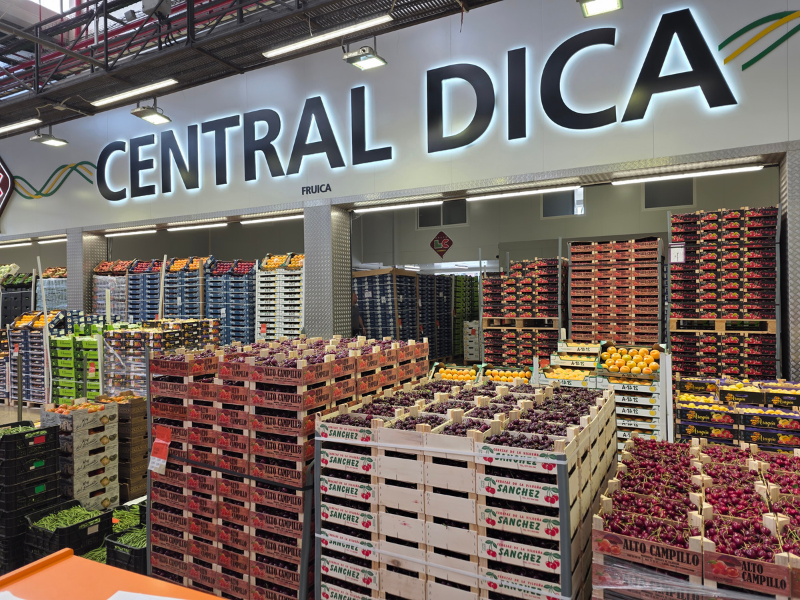
For Lorenzo Carrasco, Mercabarna remains one of the most reliable barometers of the fruit and vegetable trade. From there, he observes every day how consumer demand evolves, how European markets respond and where, in his view, a distribution system entering a new era is heading.
“We are moving towards a new business model,” the executive summarises.
He does not say this as a prediction, but as the conclusion drawn from a reality that has steadily taken shape over recent years: there are fewer and fewer traditional greengrocers, supermarkets are playing an increasingly dominant role in consumers’ purchasing decisions, and private labels threaten to dilute the value of brands, varieties and the investments companies make in marketing, innovation and research.
Summer means slower business
According to Carrasco, wholesale markets are currently experiencing a “slow” sales period. Traditionally, consumption would begin to decline in mid- or late July, as people left the major cities for the summer holidays. This year, however, the slowdown arrived during the very first weeks of July.
This situation has been compounded by another major factor: the heatwave affecting Europe. High temperatures have altered consumption patterns in destination markets, clearly favouring products such as melons and watermelons, whose sales have surged compared with other categories.
“The heatwave Europe is experiencing is enormous,” he explains.
Impact is being felt both at origin and in markets such as Barcelona, which has a strong re-export business serving other European countries.
The contrast is evident. While melon and watermelon sales continue to gain momentum, products more closely associated with colder weather are losing appeal. Carrasco cites parsnips, grown on the company’s farm in Cádiz known as “Little Holland”, as an example. A traditional winter vegetable, parsnips become difficult to market in destinations such as the United Kingdom or Germany when temperatures reach 35–36°C.
“Consumers simply don’t demand certain products during periods of extreme heat.”
Beyond the summer campaign, Carrasco believes the real issue is structural and concerns the traditional role of the wholesale markets.
RELATED NEWS: Sustainability and profitability shape Mercabarna’s management
“Supermarkets continue to grow and increase their share of consumer spending, while independent greengrocers are losing ground and struggling with the lack of generational renewal.”
This transformation is particularly noticeable in major cities such as Barcelona and Madrid. Carrasco observes a steady decline in traditional retailers and the emergence of new buyer profiles, including operators of Pakistani origin, whose purchasing criteria—according to his view—do not always match the quality standards traditionally sought by specialist greengrocers.
“The quality purchased by an independent greengrocer is not the same as that purchased by this type of operator.”
Traditional retailers, he adds, tended to look for “an extra level of quality”, whereas the current market increasingly shifts demand away from premium products towards second-category produce.
Own brands or commoditised products?
Another major issue concerns investment in branding. Companies devote significant resources to building brands, developing new varieties, communication strategies, innovation and added value. However, much of that effort can disappear once the product reaches supermarket shelves under generic categories or the retailer’s own private label.
“You have an entire marketing machine working to build the value of your brand, and then the product ends up under a private label. All that effort is diluted.”
At the same time, consumers have become increasingly price-sensitive as purchasing power declines, while certain media narratives have reinforced the perception that fruit is expensive. Carrasco believes the sector needs more rigorous communication highlighting the health benefits of fruit and vegetables.
Climate is another issue that can no longer be viewed as an occasional anomaly.
“We have to adapt to climatic pressures,” he says. “In the past, adverse weather events were exceptional; today they have become recurring.”
He recalls that market disruptions which once lasted only one or two weeks now continue for months, as happened with tomatoes earlier this year.
“It’s good for no one—not producers and not consumers.”
Mercabarna, the exception
Despite his demanding assessment of the market, Carrasco remains optimistic about Mercabarna. He believes it will continue to stand apart thanks to its concentration of operators, its logistical strength and its international vocation.
“Mercabarna is the best there is.”
In his opinion, Barcelona’s wholesale market will continue to distinguish itself through its ability to receive produce from multiple origins and redistribute it efficiently across Europe.
“The world has become a very small place.”