










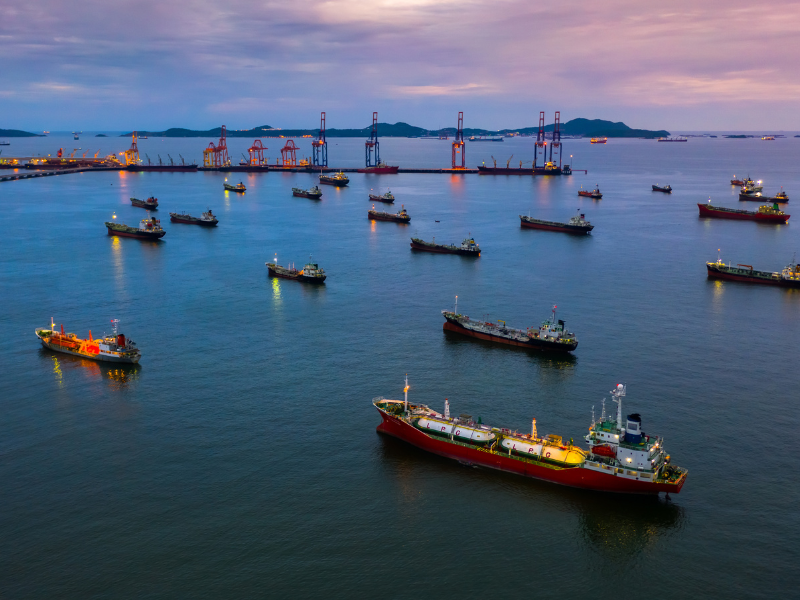
Growing instability around the Persian Gulf and the Strait of Hormuz has triggered a sharp reaction in the international crude oil shipping market.
Attacks and retaliatory actions involving Iran and the United States have increased the risks associated with navigating the region, prompting insurers to raise war-risk premiums and some shipping companies to alter routes or temporarily scale back operations.
The reduced availability of vessels willing to operate in these corridors is pushing freight rates higher, while energy markets have also responded with increases in the price of Brent crude, Europe’s main oil benchmark.
Logistics risk feeds into energy costs
The Strait of Hormuz is one of the world’s strategic routes for hydrocarbon transport, meaning that any prolonged disruption can have consequences far beyond the Middle East.
Higher shipping and insurance costs can ultimately be passed on to the price of crude oil and, subsequently, to fuel and energy costs for businesses and households.
For sectors heavily dependent on transport, refrigeration, handling or distribution, a sustained rise in energy costs could also place additional pressure on operating margins.
Spain exposed to higher logistics costs
Spain’s dependence on imported hydrocarbons means that a prolonged escalation could have a direct impact on energy costs and contribute to renewed inflationary pressures.
There is also the potential impact on international supply chains. The ports of Algeciras and Valencia, both strategic hubs for trade between Asia and Europe, are indirectly exposed to any significant disruption affecting routes through the Red Sea and the Suez Canal.
Spanish companies with commercial links to the Middle East and Asia therefore face a combination of higher logistics and energy costs and reduced predictability in supply times.
Greater uncertainty for international supply chains
In this environment, companies with a high dependence on international trade are being forced to reassess routes, sourcing strategies and risk management policies.
If the crisis persists, the effects could extend beyond crude oil prices to wider transport costs and the competitiveness of European companies that rely on long-distance supply chains.
RELATED NEWS: War in Iran puts the global agri-food system under pressure
The final impact will depend on the duration of the tensions and their effect on navigation through the region’s main maritime routes. For now, the sharp rise in tanker freight rates once again highlights how closely geopolitics, energy and logistics are interconnected in international trade.