


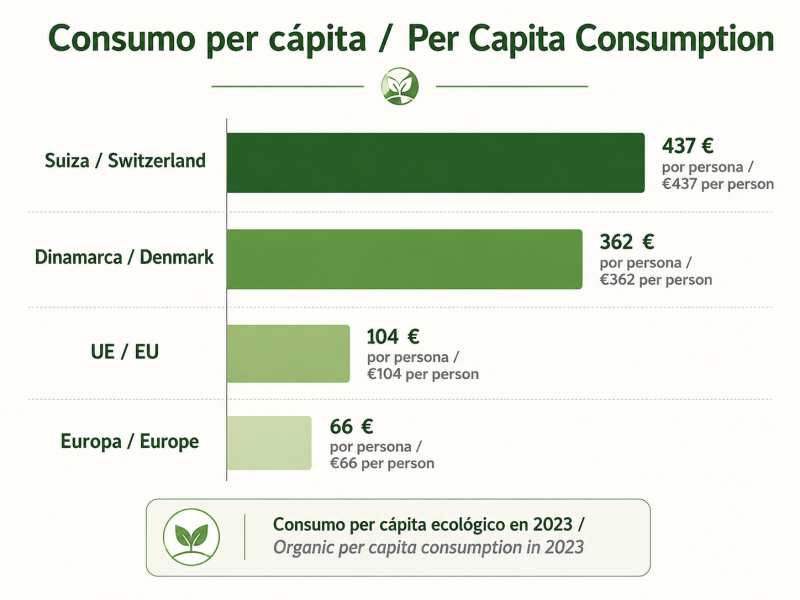
According to the European Environment Agency, based on Eurostat data, the EU’s organic farmland reached 16.9 million hectares in 2022, compared with 15.9 million hectares in 2021 and 14.7 million hectares in 2020. For 2023, the European Environment Agency reports 17.4 million hectares and 10.8% of utilised agricultural area (UAA), while FiBL (Research Institute of Organic Agriculture) estimates 17.7 million hectares and 10.9%.
The compound annual growth rate between 2012 and 2023 was 5.7%, although the EU would need to accelerate significantly to meet its 2030 target of 25%.
European countries with the largest organic farming area
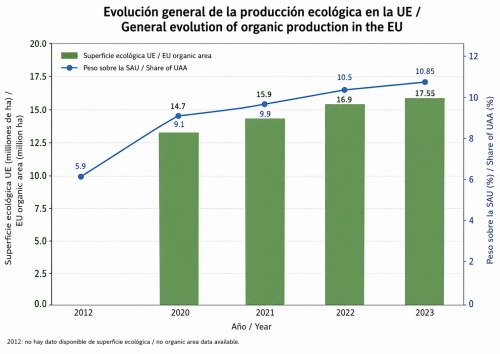
According to FiBL/IFOAM (International Federation of Organic Agriculture Movements), Spain overtook France in 2023 to become the European country with the largest organic farming area, reaching 3 million hectares.
France, which is showing signs of slowdown, followed with 2.8 million hectares, while Italy, one of Europe’s leading organic producers, reached 2.5 million hectares.
In Germany, organic farmland covers approximately 1.9 million hectares, representing around 11.5% of the country’s agricultural area. Germany is both a major consumer market and a significant producer.
Countries with the highest share of organic farming
In this case, the focus is not on absolute size but on the proportion of national farmland managed organically.
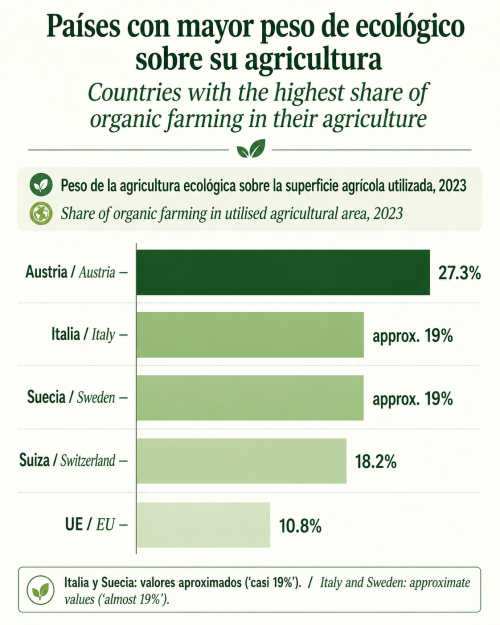
Austria ranked as the EU country with the highest organic share, with 27.3% of its agricultural area under organic management in 2023.
Italy and Sweden were both close to 19%, well above the EU average, while Switzerland, outside the EU, reached 18.2%, supported by strong consumption and production levels.
Fastest-growing countries
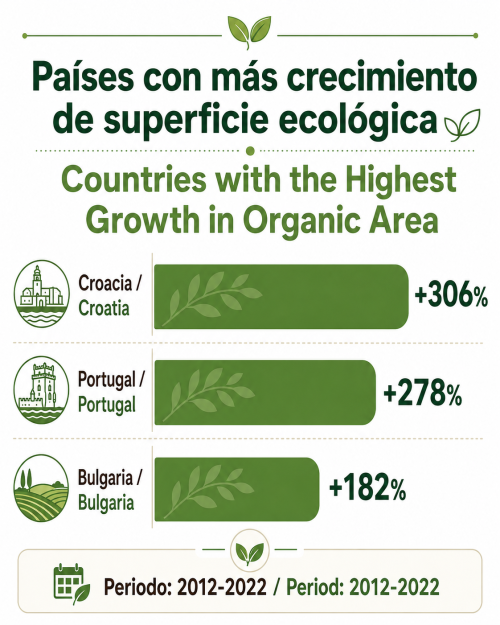
Eurostat indicates that between 2012 and 2022, organic farmland increased in almost every EU country.
During the 2012–2021 period, Portugal and Croatia nearly quadrupled their organic area, while France expanded by 169%, Hungary by 125% and Romania by 101%.
Recent signs of slowdown
Although the long-term trend remains positive, signs of slowdown have emerged in some countries since 2022–2023.
The European Environment Agency notes that in 2023, ten Member States recorded year-on-year declines compared with 2022, the highest number observed since 2012.
The Agency also highlights Poland as the only country showing an overall decline in organic share between 2012 and 2023, although growth resumed after 2020.
France provides the clearest example of recent pressure. In 2023, French organic farmland declined for the first time after years of expansion, losing around 54,000 hectares and falling from 10.5% to 10.36% of total agricultural area.
Organic consumption: FiBL/IFOAM data
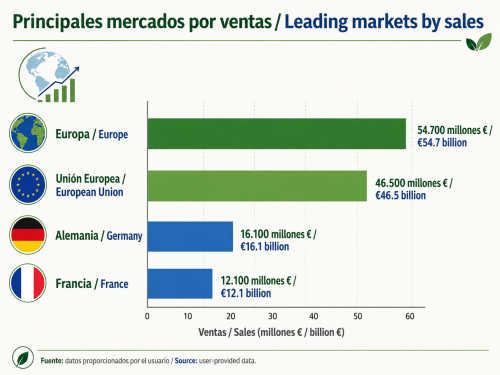
According to FiBL/IFOAM, retail sales of organic products in Europe reached €54.7 billion in 2023, of which €46.5 billion corresponded to the European Union.
The European organic market grew by 3.0% in 2023, while the EU market expanded by 2.9%, following the decline or stagnation observed in 2022.
Germany remains Europe’s largest organic market, with €16.1 billion in sales in 2023, followed by France with €12.1 billion.
Per capita consumption
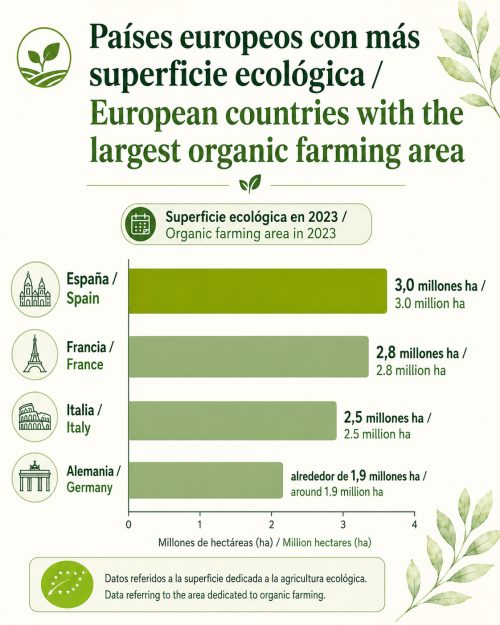
Denmark led in 2023 in terms of the share of organic products within the food market, reaching 11.8%, followed by Switzerland at 11.6%.
In per capita consumption, Switzerland and Denmark ranked highest, with €437 and €362 per person respectively.