





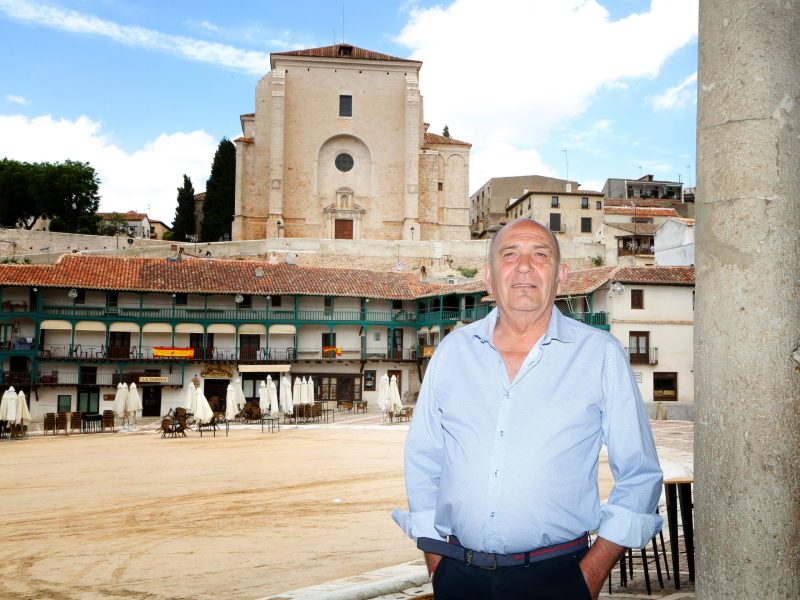
The company, historically based in Villaconejos, has already begun operating from its new premises, located just five kilometres from the original facility. The site covers 15,000 square metres, while the building itself will occupy between 5,000 and 5,500 square metres, although the company will continue working from both locations.
“We are taking things gradually, but we are already working there. We are now packing watermelons in the new facility and have also started handling melons,” explains Antonio Agudo, owner of the company.
The project is still in an adjustment phase, mainly due to delays in the arrival and installation of some machinery, but the facilities are expected to be fully operational shortly. For Agudo, the expansion comes at a key moment, as workloads increase and watermelon gains an increasingly important role within the company’s business.
Watermelon gains prominence
El Melonero added watermelon to its portfolio only six or seven years ago, but the category’s development has surprised even the company itself. Initially, the firm worked mainly with black watermelon, although the growth of striped watermelon has been much faster than expected.
“We have been very surprised by the development of striped watermelon. Our original idea was to focus on black watermelon, but striped varieties have grown to account for almost 50%,” says Agudo.
The company now handles both types in fairly equal proportions, with demand boosted by the high temperatures recorded in both Spain and Europe.
According to the owner of El Melonero, heat is a decisive factor in consumption.
“Heat is fundamental for us. The hotter it is, the greater the consumption,” he says.
In this context, watermelon is performing particularly strongly, with growth in volumes outpacing that of melon.
The company closed the previous season with a combined volume of approximately 21 million kilos of melon and watermelon, with melon still accounting for the larger share. However, the trend clearly points towards continued growth in watermelon.
“Sales have risen considerably this year. Melon sales are also up, but the increase in watermelon is stronger,” Agudo explains, while noting that final figures are not yet available.
A season marked by quality and consumption
The current campaign is progressing positively for El Melonero. Following a winter import season in which Brazil performed well due to product quality, while Senegal experienced some supply shortages, the transition to domestic origins took place without major disruption.
The arrival of produce from Almería and Murcia ensured a smooth transition between campaigns, and Agudo particularly highlights the quality of the Murcian product.
“The produce is arriving in excellent condition and looking very attractive, which really encourages consumption,” he says.
The company has also begun working with watermelons from Castilla-La Mancha, while the arrival of melons from the region was about to begin. According to Agudo, the crops look promising and have not been affected by sudden temperature changes or rainfall, two particularly sensitive factors for melon and watermelon.
Despite the heatwaves, he believes drip irrigation is helping plants remain in good condition.
“With drip irrigation, the crops are coping quite well. In the past, growers might irrigate three days a week, whereas now, if five days are needed, they irrigate five,” he explains, while acknowledging that farming always involves a degree of uncertainty.
The importance of packing
The new Aranjuez facility responds not only to a need for additional space, but also forms part of El Melonero’s commitment to protecting product quality after harvest. For Agudo, quality in the field is essential, but handling in the packhouse is equally decisive.
“It is very important to know what you are harvesting in the field, but it is even more important to handle it correctly afterwards and carry out the grading properly,” he stresses.
The company operates a system in which specialists perform an initial selection before the product reaches the packers. This means the different quality categories are already separated in advance, improving precision throughout the process.
This model enables the company to maintain a very clear positioning, particularly in watermelon, where El Melonero has chosen to operate exclusively in the premium segment.
RELATED NEWS: El Melonero grows and bets on premium watermelon
“We only handle premium watermelons. We do not enter into price wars or promotional battles,” Agudo states.
The company offers boxes containing one, two, three or four pieces, always within the same premium-quality positioning.
In melon, by contrast, the company offers a broader range, from higher-value produce to more competitively priced references. Watermelon, however, has become a strategically defined category from a commercial perspective.
At present, the company’s sales structure remains primarily domestic, with 80% of sales destined for the Spanish market and around 20% for export.