








PC Fruit, the fruit research centre, has warned that in some cases the damage has been total. “For some growers, the entire crop has been destroyed by hail and can no longer be harvested,” the organisation said. Although hail episodes are not unusual in fruit production, the current concern lies in how frequently they are now occurring.
Severe storms in Flanders
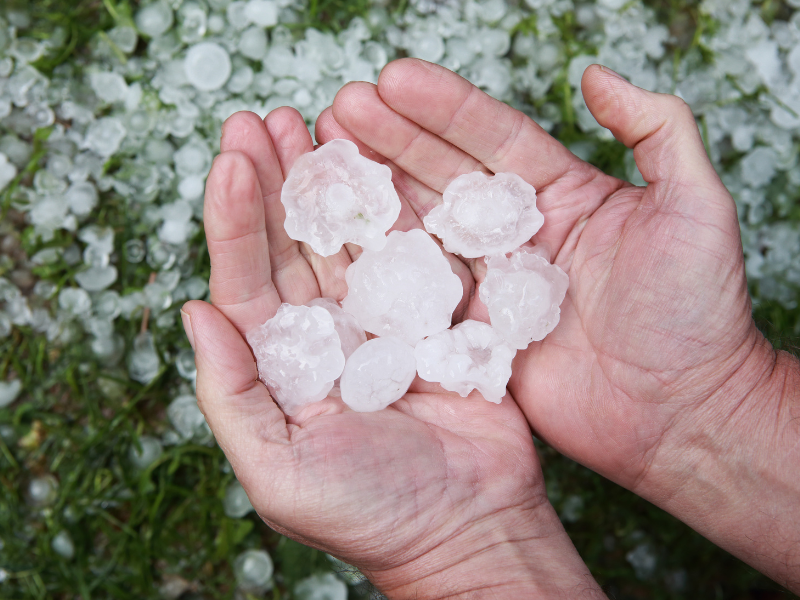
The storms left streets flooded in Leuven and hailstones the size of ping-pong balls in Malderen. The Haspengouw region, one of Belgium’s main fruit-growing areas, was also seriously affected, with several growers reporting damage to their farms.
“We do not yet have a complete overview, but it is already clear that hail has caused major damage in some regions. Some plots have been completely destroyed,” said Dany Bylemans, director of the Proefcentrum Fruitteelt in Sint-Truiden.
At the fruit and vegetable cooperative BelOrta, an initial estimate has already been made. Kris Jans, the cooperative’s fruit director, said that both water and hail damage had been recorded. Heavy rainfall in recent weeks had already caused cracking in some varieties, while local hail damage has worsened the situation. BelOrta estimates losses at around 20%.
Cherries hit hard before harvest
Hail has had a particularly severe impact on cherry production, which was at a highly sensitive stage just before harvest. Vincent Van Kerckvoorde, cherry cultivation advisor at PC Fruit, confirmed that he had been contacted by growers from Dormaal, Borgloon and Lanaken.
According to him, some growers will no longer be able to harvest because the hail has completely destroyed the fruit. In cherries, damage before harvest can be devastating for commercial yield, as the fruit either loses value or is left completely unsaleable.
Anti-hail nets remain a costly investment
In recent years, many Flemish fruit growers have invested in anti-hail nets and protection systems. In the case of BelOrta, for example, around 38% of the cherry area is covered and therefore better protected against heavy rain or hail.
However, these structures require a significant investment and not all farms can afford them. The limited profitability of some crops, especially apples, has made it less attractive for many growers to install anti-hail nets.
Fruit grower Brecht Geerdens, from Diepenbeek, explained that his Golden Delicious apples are not protected by nets, while his club varieties are. In pear production, however, these systems are rarely used because they block too much light. In addition, pears are more resistant to slight hail damage thanks to their thicker, rougher skin, whereas in apples the commercial impact of hail is usually much greater.
Increasingly frequent episodes
Although hail is part of the usual risks in fruit production, PC Fruit warns that the frequency of these events has increased significantly. Bylemans recalls that hailstorms used to be more concentrated in specific periods of the year, especially after hot spells in July or August.
RELATED NEWS: South African fruit suffers heavy losses after tornado and hailstorm
Now, however, they can occur in any season. The PC Fruit director links this trend to global warming and stronger temperature contrasts. According to him, hail mainly forms when there are large temperature differences, a situation that is becoming increasingly common: after relatively cool periods, temperatures rise sharply and then fall again quickly, favouring violent storms.
Damage to greenhouses, solar panels and vegetable crops
The storm has not only affected fruit crops. Boerenbond, the main Flemish farmers’ organisation, has also received reports from farmers whose infrastructure has been damaged.
The organisation said the storms were very localised, with intense episodes in areas such as Londerzeel, Malderen and Buggenhout, near the border between East Flanders, Antwerp and Flemish Brabant. Damage has been reported to steel structures, solar panels and greenhouses.
Damage has also been reported in cabbage crops and asparagus fields, extending the impact of the storm beyond the fruit sector.
The episode once again highlights the vulnerability of European agriculture to increasingly frequent extreme weather events, as well as the difficulty of protecting all farms with investments that, in many cases, are hard to amortise.