








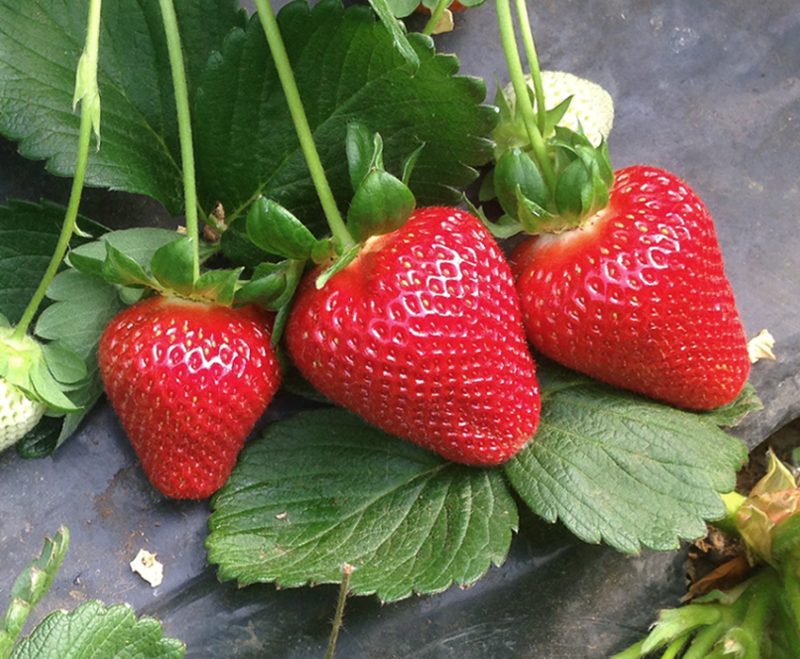
The Regional Ministry of University, Research and Innovation has funded this project carried out by the University of Málaga and La Mayora, which will make it possible to use molecular markers in assisted breeding programmes, as well as identify targets for the development of new varieties adapted to climate change at a lower cost and within shorter timeframes.
The study, conducted simultaneously in five European countries — Norway, France, Italy, Poland and Germany — reveals that the environment and its interaction with the crop are key factors in fruit development and growth. In this regard, the research team demonstrated that crops behave differently depending on the environment, the production method and the fruit’s own genetics, as well as the interaction between these variables.
These findings are detailed in the paper “Cultivar-by-environment interactions shape strawberry fruit quality: A multi-omics approach across European climates”, published in the journal Food Chemistry.
The study concludes that warm climates and high temperatures accelerate ripening and shorten fruit development, increasing acidity. By contrast, milder temperatures favour the accumulation of sugars and aromatic compounds, improving strawberry flavour.
Four strawberry varieties, five different countries
To obtain these results, the team analysed four strawberry varieties — Clery, Frida, Gariguette and Sonata — grown under different conditions.
The crops were cultivated in open fields in Norway, Germany and Poland, and in polyethylene tunnels located in production areas in Italy and France.
Across all locations, researchers applied techniques capable of measuring large-scale molecular biological information, ranging from DNA and RNA to metabolites, which represent the final chemical expression of the fruit’s genome.
They also employed advanced mathematical models and multivariate analysis, laying the foundations for future machine-learning and artificial intelligence models applied to plant breeding.
The complexity of strawberries
The cultivated strawberry is an octoploid species, meaning that it contains eight copies of its genome. This characteristic makes both its study and genetic improvement considerably more complex.
To manage the enormous number of variables generated by the fruit’s genetic and chemical analyses, researchers applied the PERMANOVA test, a statistical technique that identifies significant differences between groups of samples while considering multiple variables simultaneously.
RELATED NEWS: Berries prepare for their XI International Congress
“The volume of data we work with is massive. We are talking about gigabytes and terabytes of information,” explain researchers from the University of Málaga.
In this context, the team highlights the need to develop varieties that combine sensory quality, stability and adaptability to different production systems.
“The fact that varieties do not behave in the same way across different ecosystems provides key information to accelerate plant breeding. Developing a new strawberry variety through conventional methods takes between eight and twelve years. With marker-assisted selection and current technologies such as genome editing, this timeframe can be reduced to two to four years, while also lowering costs for growers,” the researchers emphasise.