








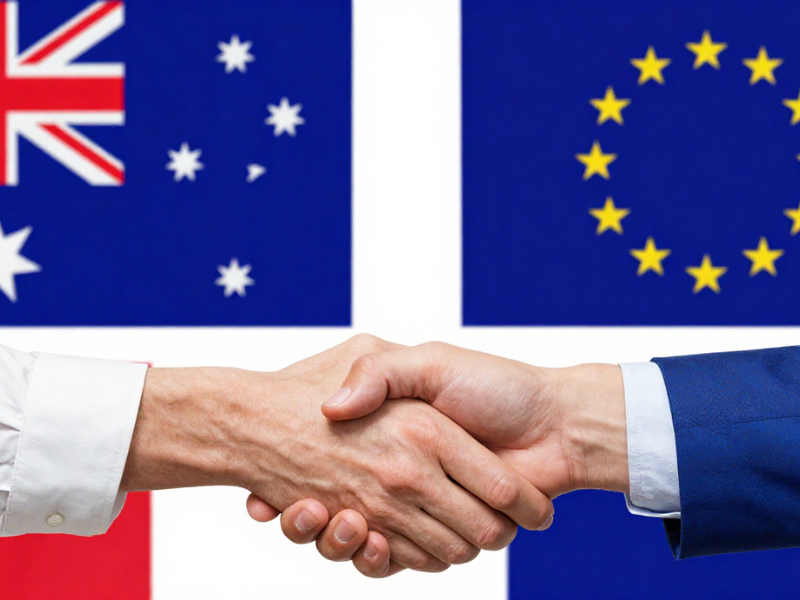
Australian Prime Minister Anthony Albanese announced the agreement at a press conference in Canberra, describing it as “a significant moment” for the country, highlighting that it involves “the world’s second-largest economy” and will help reduce trade and investment barriers.
“The free trade agreement between Australia and the European Union will reduce barriers to trade and investment,” Albanese said, noting that the deal is expected to generate around AUD 10 billion (€6 billion) annually for the Australian economy.
The agreement will remove tariffs on key Australian exports such as wine, seafood and horticultural products, and will expand access to the European market for goods including beef, lamb, dairy, rice and sugar. It will also facilitate duty-free entry for Australian industrial goods.
The President of the European Commission, Ursula von der Leyen, emphasised that the agreement will benefit both sides and strengthen cooperation in an uncertain global context.
“This agreement will add nearly $8 billion to GDP,” she said, adding that “all Australian industrial goods exported to the European Union will be tariff-free.”
Von der Leyen also underlined the importance of advancing trade agreements in a changing global landscape. “Today we are telling an important story to a world that is changing profoundly,” she said, adding that “rules-based open trade delivers positive outcomes.”
RELATED NEWS: European promotion budget to reach €160 million
The deal will also make it easier for Australian citizens and businesses to provide services in the European market, while creating new opportunities for European exporters, whose shipments to Australia are expected to grow over the next decade.
In parallel, both sides announced a new partnership on security and defence aimed at strengthening cooperation in areas such as the defence industry, maritime security, cyberspace, and the fight against terrorism and disinformation, in line with their shared commitment to global security.
Australia and the EU also agreed to begin negotiations for Australia’s participation in the Horizon Europe research programme from 2027, enabling institutions in the country to access funding and collaborate on international scientific projects.
Negotiations, which began nearly ten years ago, faced several points of friction, particularly regarding agricultural quotas and the use of European geographical indications such as “feta” or “prosecco”, delaying the conclusion of the agreement until now.