







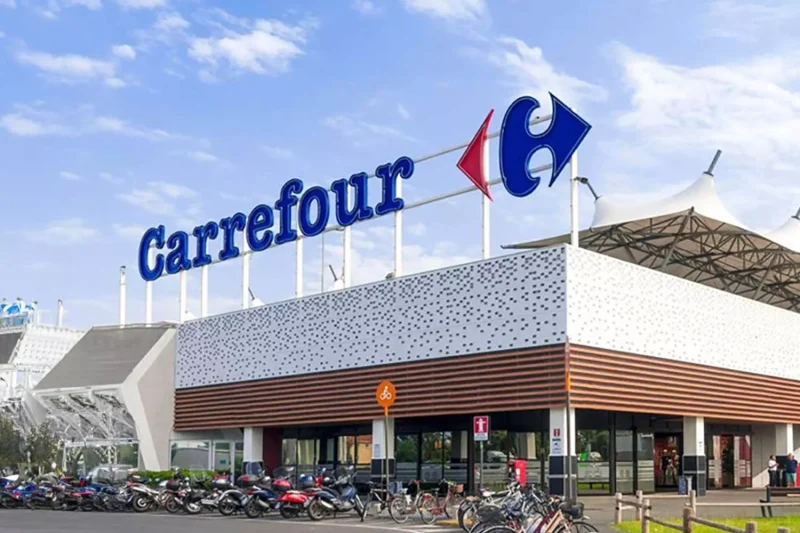
Digital transformation in large-scale retail has moved beyond the pilot project stage and is now entering a phase of operational implementation. In Carrefour’s case, technology is already being used to address specific store-level challenges: queue management, shrinkage control, improved shelf management, team optimisation and a more efficient shopping experience.
The group dedicated a 336-square-metre space to innovation during the event, where the team led by Miguel Ángel González Gisbert, Carrefour’s Global CTO, showcased digital solutions applied directly to the day-to-day operation of the point of sale.
Hopla evolves towards more autonomous AI
One of the main advances presented was the evolution of Hopla, the generative AI assistant initially launched by Carrefour with OpenAI.
In its first phase, Hopla was focused on consumers, with functions such as creating menus based on savings and reducing food waste. Carrefour is now moving towards a more agentic form of AI, capable of going beyond answering questions and executing more complex workflows.
In practical retail terms, this means artificial intelligence will be able to support internal store and back-office tasks, automating administrative processes and freeing up teams’ time to focus on customer service and product availability on shelves.
Computer vision to improve checkouts and customer flows
The company also presented progress in its own solutions based on computer vision, with the aim of improving one of the most sensitive points in the shopping experience: checkout.
Among these tools is SCO Vision, a system integrated into self-checkout terminals that analyses the scanning process in real time. Its goal is to reduce unintentional errors, especially with complex products or items without barcodes, as can occur with some fresh produce references, while helping to control shrinkage without slowing down payment.
Another solution is Flow Vision, designed to manage customer flows and queues. The tool can anticipate congestion at checkout points and monitor movement in store, making it easier to organise staff shifts more efficiently.
The shelf becomes smarter
Carrefour’s technological rollout also strengthens its partnership with VusionGroup to advance shelf digitalisation. Electronic shelf labels are no longer merely a tool for updating prices; they are becoming connected information points.
This development enables light-guided functions to support replenishment tasks, reduce out-of-stocks and speed up e-commerce order preparation. It also opens the door to providing consumers with more information at the point of purchase, such as data on allergens or carbon footprint.
In the case of food and fresh produce, these tools can be particularly relevant for improving availability, traceability and product-related information in store.
Technology also depends on store teams
Carrefour’s strategy highlights that digital transformation in retail does not depend solely on the implementation of new tools, but also on their adoption by store staff.
To this end, the group has presented initiatives linked to the modernisation of the digital workplace and the internal “AI for all” training programme, designed to train teams in the use of these new solutions.
RELATED NEWS: Carrefour markets 400 million kilos of Spanish fruit and vegetables
The company aims to ensure that artificial intelligence and automation do not operate as isolated elements, but as tools fully integrated into the daily running of supermarkets.
From innovation to operational return
Carrefour’s Grand Salon National reflects an increasingly clear trend in European large-scale retail: artificial intelligence is no longer measured solely by its technological capacity, but by its real impact in store.
Reducing errors, improving efficiency, optimising staff, controlling shrinkage and enhancing the shopping experience have become the main indicators of value.
With this rollout, Carrefour is accelerating the transition from technological experimentation to real scale, positioning AI as an operational tool to strengthen the competitiveness of food retail.