








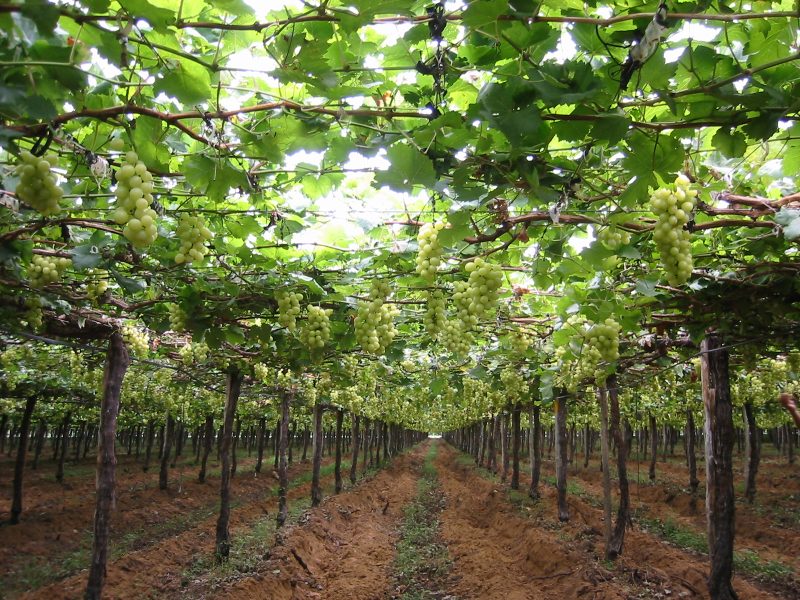
Joaquín Gómez, President of APOEXPA, discusses the position of the Spanish table grape industry, the emergence of new competitors and the opportunities this event offers to reinforce Murcia’s role as Europe’s leading table grape region.
Murcia is set to become the global centre of the table grape industry. What does it mean for APOEXPA that the Region has been selected to host this event?
It is a tremendous recognition of the work we have carried out over many years. APOEXPA is Spain’s leading association for table grapes. We spent six years—two editions of the Symposium—working to bring the event to Murcia. The decision was confirmed in South Africa, and we are confident that we will rise to the occasion.
What will be the main challenges and issues discussed?
The Symposium will address all the major challenges affecting table grapes on a global scale. Table grapes have become the third most consumed fruit in the world, the category has become de-seasonalised, and consumers now enjoy grapes throughout all twelve months of the year.
These challenges affect both hemispheres and all five continents. Discussions will cover plant protection products, climate change, new varieties, disease resistance and new genomic techniques. These are issues that concern the entire industry and will be of great interest to all participants.
What opportunities could this Symposium create for the Spanish table grape sector?
The main opportunity is for Spain to establish itself as Europe’s benchmark for table grapes. We are not the largest producer—Italy’s production is almost four times higher than ours.
However, hosting the Symposium, opening new markets and the fact that Murcia is home to world-leading breeding companies such as ITUM and Bloom Fresh mean that, although we may not be the biggest producer, we have every opportunity to become one of the sector’s leading international references.
Climate change is expected to be one of the main topics. How is it affecting production?
Climate change has become the greatest challenge facing the fruit and vegetable sector, and therefore also the table grape industry. Rising temperatures, particularly the persistence of hot days and exceptionally warm nights, mean that fruit no longer behaves as it did only a few years ago.
RELATED NEWS: Grapes break the calendar and redraw the global map
This is an undeniable reality that we must face and adapt to. Areas where grape production would have been unimaginable five years ago are now becoming viable. Competition can emerge from almost anywhere, but at the same time new opportunities are also appearing.
Climate change, together with its impact on plant health, may become one of the industry’s greatest challenges while also creating new opportunities in the years ahead.
What position does Murcia’s table grape industry hold in the global market in terms of production and exports?
We are neither the largest producer nor the largest exporter; we occupy a middle position.
In seedless grapes, however, we have at times supplied almost the entire European market. Nevertheless, following its major varietal renewal programme, Italy has become our strongest competitor in Europe, alongside Egypt.
Even so, I believe our position is well established, and the outlook for the future remains positive.
Is Spain at the forefront of global production and innovation?
Without question, Spain is at the forefront of the global table grape industry in many areas. We have succeeded in creating an outstanding ecosystem encompassing research, production and market development.
When people think about Europe’s table grape hub, research activities or the location of some of the world’s leading producers, they think of Spain.
For several months each year, Murcia becomes the international centre not only of production but also of visits from professionals across the world. Having **two of the four leading global breeding centres—Bloom Fresh and ITUM—**located in the Region makes Murcia a benchmark for innovation within the sector.
How can table grape consumption continue to grow?
I believe consumption is increasing exponentially thanks to the characteristics of the new varieties being developed, offering different colours, flavours and concepts adapted to changing consumer trends.
Furthermore, today’s seedless table grapes, presented in a completely natural format, could almost be regarded as a natural fresh-cut product. They are one of the easiest and most convenient fruits available to consumers today.