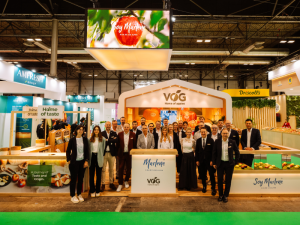





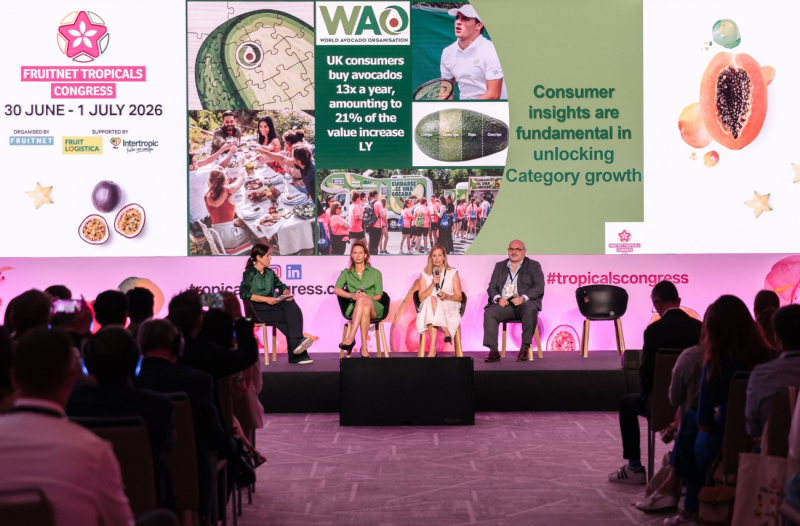
The World Avocado Organization (WAO) took part in Fruitnet Tropicals Congress 2026, held in Barcelona, one of the leading European events for the tropical fruit sector. During the congress, which brought together more than 150 professionals from 20 countries, including growers, exporters, retailers and industry experts, Shelly Vorster, Managing Director of WAO, shared the organisation’s vision for the future of the category in Europe, focusing on one key aspect: gaining a deeper understanding of the consumer.
Over the past year, WAO has analysed more than half a million consumers across nine markets to better understand how to connect with each type of consumer. This research has identified significant differences between emerging and more mature markets, confirming that there is no single strategy that works across the whole of Europe.
The results show very different realities. In emerging markets such as Italy and Poland, avocados are still at an early stage of development, with many consumers not yet familiar with the product or all its consumption possibilities. In Italy, for example, only 35% of consumers took avocados home over the past year, a figure that reflects the market’s enormous growth potential. Consumption also tends to be concentrated at weekends, associated with gatherings with family and friends.
RELATED NEWS: Peru tests Green Motion’s new generation of avocados and rootstocks
However, in markets such as the United Kingdom, where avocados have been present for around 40 years, consumers are already familiar with the product and incorporate it naturally into their daily routines. In more mature markets such as Spain, France and the UK, the challenge is no longer to raise awareness of the product, but to inspire new consumption occasions beyond breakfast toast or salads.
“Household penetration, in other words, the number of consumers buying avocados to take home, is not growing significantly year after year. Ultimately, avocados remain an impulse purchase and not a product that most consumers always have on their shopping list,” explained Shelly Vorster during her presentation.
This is particularly relevant in a context in which price sensitivity remains one of the main challenges for the category. According to the data presented by WAO, a 1% change in the price of avocados in Europe moves sales volume by an average of 2.6%, demonstrating the importance of continuing to strengthen the perceived value of the product.
Retail as a key point of activation
This consumer knowledge is also being applied at the point of sale. The organisation currently works with 31 retailers across Europe, developing campaigns adapted both to regular consumers and to new buyers, with the aim of turning awareness into purchase.
“Social media is fantastic for increasing product awareness, but we need to act at the moment of purchase to get consumers to put an avocado in their basket. That moment is fundamental because, in Europe, avocados are still, in many cases, an impulse purchase and not a product consumers always have on their shopping list. That is why capturing consumers’ attention while they are shopping and encouraging them to add an avocado to their basket has a direct impact on category growth,” said Vorster.
When the objective is to increase purchase frequency among existing consumers, WAO focuses on actions within the category itself. As Shelly explained, “we have seen that cross-promotions work particularly well. In Germany, for example, bread and avocados go hand in hand. Placing promotional materials in the bread section encourages consumers to add an avocado to their basket and generates double-digit sales growth.”
However, when the aim is to attract new buyers, the strategy changes completely. In these cases, the organisation opts for displays outside the usual category, placing avocados alongside other fruit to encourage impulse purchases.
“When we want to attract new consumers, we need to take the product out of the category. If these people do not have avocados on their shopping list, they will never go looking for them on the shelf. But if they find an avocado display next to bananas at the entrance of the supermarket, traffic and purchases increase significantly,” she added.
Gen Z, Millennials and the need to speak the consumer’s language
During the congress, WAO also highlighted the importance of connecting with younger generations to secure the future growth of the category. To this end, the organisation is developing specific campaigns aimed at Gen Z and Millennials through TikTok, Instagram and Facebook, as well as experiential marketing and public relations.
“If we want to secure the future of the category, we must focus on Generation Z and Millennials, and on social media. We are working on this through social media in every country, but the rest of the tropical sector also needs to understand the consumer much better, understand how they think and learn to speak their language. Today, that language is on Instagram and TikTok. The opportunities for further growth are enormous,” said Vorster.
Beyond driving purchases, WAO recalled that there is still significant work to be done in terms of education about the product itself. According to the data shared during the congress, 42% of European consumers do not know that avocados grow on trees, a figure that highlights the distance that still exists between consumers and the origin of food.
For WAO, strengthening education and inspiring new uses and consumption occasions remain priorities to consolidate the growth of the avocado category in Europe.
With its participation in Fruitnet Tropicals Congress 2026, the World Avocado Organization reaffirms its commitment to the sustainable growth of the category in Europe, focusing on a strategy based on consumer knowledge, collaboration with retail and the development of actions adapted to the needs of each market.