








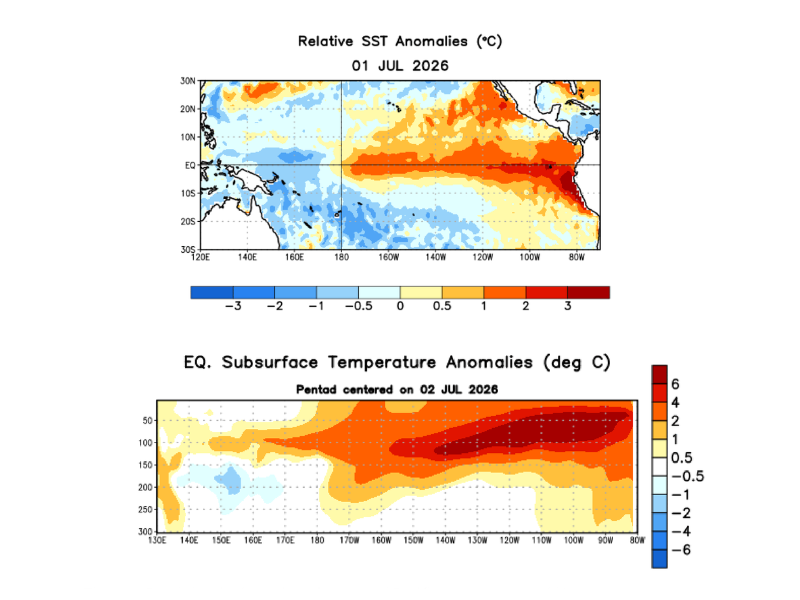
The El Niño phenomenon continues to strengthen and is expected to intensify further through the end of the year. According to the latest update from the Climate Prediction Center/NCEP/NWS, part of NOAA, the alert system remains at El Niño Advisory status and estimates a 97% probability that the episode will persist until early spring 2027.
The report, published on 9 July 2026, confirms that sea surface temperature anomalies exceed +1.0°C across a large area of the central and eastern equatorial Pacific. The latest weekly Niño-3.4 index stood at +1.2°C, while the Niño-1+2 index reached +2.7°C, reflecting significant warming in the eastern Pacific.
High probability of a very strong event
Climate models indicate that El Niño will continue to strengthen during 2026. NOAA states that there is an 81% probability that the event will reach very strong intensity between October and December, which would place it among the most intense El Niño events recorded since 1950.
The World Meteorological Organization (WMO) also warns that El Niño conditions are already underway and are expected to strengthen rapidly into a strong event. According to the WMO, this development will increase the likelihood of droughts, heavy rainfall, land heatwaves and marine heatwaves in many regions of the world.
However, climate agencies also stress that El Niño’s impacts are not uniform. Even the strongest events do not produce the same effects everywhere, although they do increase the probability of certain extreme weather patterns.
A key phenomenon for agriculture
El Niño is one of the main sources of interannual climate variability. It occurs when surface waters in the central and eastern Pacific warm abnormally, altering rainfall and temperature patterns in different parts of the world. According to the FAO, these changes can directly affect agriculture, livestock, fisheries, water resources and rural livelihoods.
The United Nations agency recalls that climate risks associated with El Niño can threaten food security, especially when they cause droughts, floods or disruptions to agricultural calendars. It therefore stresses the importance of activating anticipatory measures to protect crops, livestock, productive land, water and infrastructure before impacts translate into losses.
Agricultural regions under watch
The effects of El Niño vary by region. The FAO notes that, historically, in parts of Southeast Asia and South Asia, the phenomenon can favour below-normal rainfall during the monsoon, while in areas of southern Africa it has been associated with lower rainfall between November and March, coinciding with the main agricultural season.
RELATED NEWS: Peruvian blueberry sector prepares for potential El Niño impacts
In Central America, especially in the so-called Dry Corridor, El Niño is often linked to drier conditions between June and December, with possible effects on agricultural campaigns. In northern South America, it has also historically been associated with below-average rainfall between June and March of the following year.
For the global agri-food sector, this scenario requires close monitoring of water availability, temperature trends, sowing and harvesting calendars, crop pressure and the stability of supply chains.
Additional risk for markets and supply
A strong El Niño event can have significant effects on agricultural markets, not only because of its direct impact on production, but also because of its influence on logistics, costs, the availability of specific origins and commercial planning.
In the fruit and vegetable sector, the evolution of the phenomenon will be particularly important for products grown in regions sensitive to changes in rainfall and temperature. Prolonged droughts, torrential rains or extreme heat episodes can affect size, quality, yields, plant health and supply continuity.
Planning and anticipation
The WMO stresses that seasonal forecasting systems and early warnings are essential tools to reduce the economic and social impact of extreme weather events.
In this context, the evolution of El Niño over the coming months will be a key factor for growers, exporters, importers, retailers and logistics operators. Water planning, origin diversification, climate risk monitoring and commercial anticipation are gaining importance in the face of an event that could shape much of the global agricultural campaign through 2027.