






I thought you were French.
I am by birth, but I have always chosen not to have French documentation. My passport is Spanish. I did not want to lose the connection with my roots, and I do not think there is a better way of maintaining it.
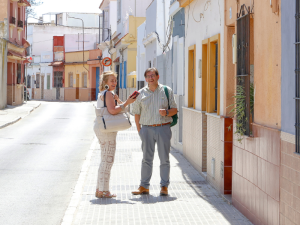
I noticed that during the tour of the city we have just taken.
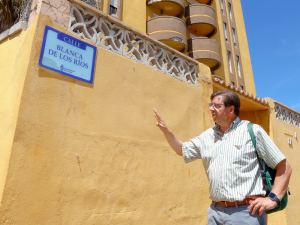
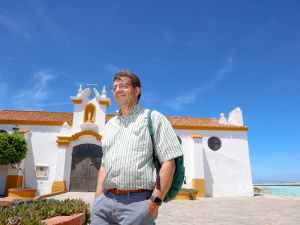
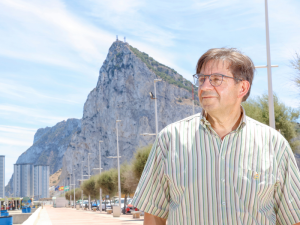
Yes, I wanted to show you places that are closely connected to my family. They all bring back good memories. From Oquendo and Blanca de los Ríos streets to Calle Colón, as well as the Parroquia de los Marineros in La Atunara, which embodies the town’s seafaring identity.
You also speak perfect Spanish, although I imagine your education was entirely French.
Yes, it was. I was educated in France, I think in French and I read in French.
I am enormously grateful to France. Thanks to its education system, I was able to go to university despite having limited means, and I believe that having two cultures is a source of richness that allows you to see things from another perspective.
What did you study? I assume Economics or Business Studies.
Wrong diagnosis. I am very much a humanities person. I studied English and Spanish Philology. At 50, just as my daughter started university, I enrolled in what would be the equivalent of Business Administration in Spain. Although it is true that my academic background is something of a mix, because I completed technical secondary education before turning to the humanities.
I would never have imagined that humanities were your field, except perhaps because of how much you talk.
[Laughs.] Yes, that is true. Give me five minutes and I can talk for two hours. I am dangerous. I also like to call things by their name, and that has sometimes got me into trouble.
Fortunately, in France, if you are a foreign national, you cannot hold political office beyond the municipal level, because otherwise I think that might have been my path. In fact, I was a municipal councillor in Macheren, where I live.
Wait, I will ask you about your public positions later, because while preparing for this interview I saw that there have been quite a few.
What memories does La Línea bring back for you?
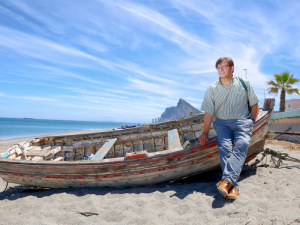
All of them. My mother and father are buried here. And I grew up in a fishing neighbourhood because one of my father’s occupations was as a fisherman. Here, as well as celebrating the Immaculate Conception, the patron saint of the city, we celebrate Our Lady of Mount Carmel, patron saint of seafarers. We used to spend almost the entire day playing on the beach or in the street. I also remember that during the summers my uncle, who worked at a secondary school, would give us English lessons.
After your visit to the cemetery, I have to ask whether you are a believer.
Basically, the answer is yes, although I have gone through periods of agnosticism.
What an honour to have been recognised by the mayor with the city’s insignia!
Yes, indeed. I simply represent so many others who left this place and went on to do well in life. People always talk about the bad things, but there are so many good ones too!
This recognition is significant, but you have also received one of France’s most highly regarded honours: in 2024, you were appointed a Knight of the French Order of Agricultural Merit, following a proposal by the Ministry of Agriculture.
Yes, that is right. It was a great honour. I suppose it was because of my involvement in the various projects we have carried out. I have always been involved in industry associations and in bringing people together to work towards common goals.
I do not usually like talking about work in this section, but in your case you will have to explain why you received such a distinction.
I might bore you a little. I was President of the Potato Interprofessional Committee and of Europatat’s Ware Potato Commission, I am a member of Fedepom and I was President of the CNIPT. I currently hold several other positions and serve as Managing Director of Vitalis and Vitexport. I have been working for this group for 38 years, with the same people who, in some cases, are now reaching the fourth generation.
I believe you are also involved in more altruistic activities.
On a personal level, I am very pleased to be involved with Pièces Jaunes, an association that helps parents of children with cancer and is headed by Macron’s wife. Through this involvement, I have had the opportunity to dine with him on several occasions.
I saw you reading over breakfast yesterday. What book are you currently reading?
La Lumière du bonheur, by Éric-Emmanuel Schmitt, a story about four characters across different periods of human history. My preferences have always leaned towards literature connected with history because, deep down, there is always something real behind it.
What do you usually do at weekends?
I do not like routine and, with friends, plans can always be adjusted. Last weekend, through an association twinned with Alsace, my wife and I went to visit vineyards.
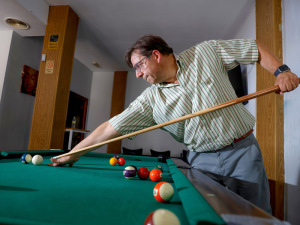
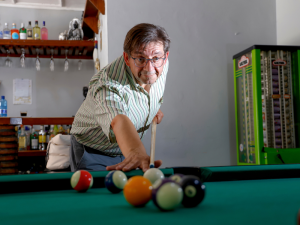
I also enjoy playing billiards, which I took up in Scottish pubs during my university years.
As an anecdote, I can tell you that during the pandemic I completed a 13,000-piece jigsaw puzzle. I always find something to keep myself occupied.