




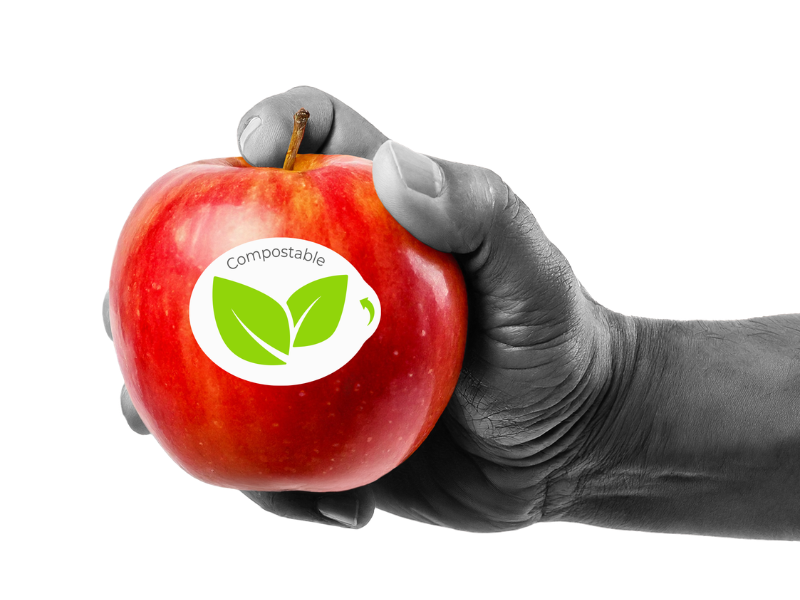
Global fresh produce labelling specialist Sinclair is focusing its efforts on one of the key challenges arising from the shift towards more sustainable packaging: helping consumers identify and correctly dispose of compostable fruit labels.
With the implementation of the Packaging and Packaging Waste Regulation (PPWR) in the European Union and the requirement for individual fruit and vegetable labels to be compostable from February 2028, the company believes it is essential to develop simpler and more practical communication strategies. The aim is to turn compostability from a packaging claim into an everyday action for consumers.
Information, key to correct waste management
Several studies highlight the need to improve communication around these materials. Research carried out in the United States in 2023 by the Composting Consortium and the Biodegradable Products Institute found that up to 49% of consumers struggle to distinguish between the terms “compostable” and “biodegradable”.
Similarly, a consumer study conducted in the United Kingdom by the Compostable Coalition showed that the number of households correctly disposing of compostable packaging increased fivefold when they received clear and consistent instructions on end-of-life management.
In response, Sinclair is working on more direct messages to guide consumers when disposing of labels. Instructions such as “Place in the compost bin” aim to remove uncertainty and facilitate correct waste separation.
T55, an established solution
The company developed T55, a fruit label with dual certification as industrially compostable and home compostable, which is currently used by more than 400 customers worldwide.
According to Sinclair, the challenge is no longer only to develop compostable materials that can operate at commercial scale, but also to ensure that consumers know what to do with them once the product reaches the end of its life.
“We have demonstrated that compostable fruit labelling works commercially and at scale across major formats and markets,” explains Duncan Jones, Senior Marketing Manager at Sinclair. For the company, the next challenge lies in those “three seconds at the waste bin”, when consumers need a clear instruction rather than another claim, symbol or packaging message to interpret.
The challenge of adapting disposal instructions
The PPWR establishes that labels applied directly to fruit and vegetables must be industrially compostable across the EU by 12 February 2028. In addition, a harmonised EU-wide label is planned to help consumers identify whether packaging is recyclable, reusable or compostable, although it is not expected before 12 August 2028.
For fruit labels specifically, Sinclair highlights an additional challenge due to their small size. These labels must provide sufficient information without compromising other essential elements such as product identification, branding or retailer requirements.
RELATED NEWS: ClemenGold® and Sinclair: A partnership driving sustainability
For this reason, the company supports a more flexible approach that allows disposal instructions to be adapted to the specific requirements of each local market before the implementation of a harmonised European system.
“A harmonised EU-wide labelling system will help, but consumer habits will take time to change,” says Jones, who believes that agile mechanisms will be needed to guide consumers both in Europe and in international markets.
For Sinclair, the next stage in the development of compostable labelling will depend not only on technological innovation, but also on consumer behaviour and the ability to communicate clearly how these new materials should be managed correctly.