







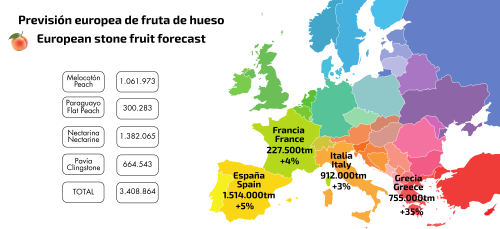
Data presented by Afrucat at the 25th Interprunus International Forum indicate that, with almost 2.74 million tonnes of peaches and nectarines, forecast production will exceed the 2025 crop by 8% and stand 16% above the 2002–2024 average.
Greece, which experienced a significant shortfall in 2025, is returning to optimal production levels, while the remaining producing countries are expected to record crops between 3% and 5% higher than last year.
As for clingstone peaches, mainly destined for processing, production is expected to reach 665,000 tonnes, representing a 10% increase compared with 2025, although still 4% below the 2020–2024 average.
To date, the campaign has not been affected by any significant climatic event. Although some isolated frost episodes may have had a limited impact in certain production areas, overall production potential has not been significantly compromised.
Italy approaches its production potential
In Italy, 2026 production is expected to reach levels close to full potential. Forecasts indicate around 867,000 tonnes of peaches and nectarines, 3% more than in 2025, while clingstone peach production is expected to remain around 45,000 tonnes, representing a slight 2% decrease.
The 2025 campaign was somewhat smaller than that of 2024, although without any major climatic disasters. The reduction in volumes was mainly due to declining planted area, particularly in peaches and clingstone peaches.
Nevertheless, market performance remained positive, supported by strong domestic and export demand, higher prices than in previous years and reduced competition from Spain and Greece.
Looking ahead to 2026, the downward trend in peach and clingstone peach acreage continues, while nectarine plantings remain more stable. Harvesting is expected to begin at similar dates to 2025 or slightly earlier.
Greece leaves the 2025 frosts behind
In Greece, 2026 production is forecast to be significantly higher than in 2025. Volumes are expected to reach nearly 455,000 tonnes of peaches and nectarines, 35% more than the previous year, and around 300,000 tonnes of clingstone peaches, an increase of 12%.
This recovery is largely explained by the fact that 2025 was a particularly poor year due to frost events in March and April.
In contrast, climatic conditions in 2026 have been much more favourable, with a normal winter and spring and no major damage reported.
From a structural perspective, the Greek sector continues to improve yields and fruit quality, although peach and clingstone peach acreage is gradually declining as some growers shift towards kiwi production.
In northern Greece, however, interest is growing in nectarines and very late peach varieties.
France maintains stable production
France is forecasting approximately 224,000 tonnes of peaches and nectarines for 2026, 4% more than in 2025 and 10% above the 2020–2024 average.
Clingstone peach production is expected to remain virtually unchanged at around 3,500 tonnes.
RELATED NEWS: Europe expects peach and nectarine crop to rise by 9% in 2026
The 2025 campaign was uneven: initially, there was a shortage of fruit on the European market, but later supply became excessive, particularly for small-sized nectarines.
As a result, growers will need to pay particular attention to thinning practices in 2026 to achieve larger fruit sizes and higher market value.
Structurally, French production appears stable thanks to a strong rate of orchard renewal. Nectarines continue to dominate, accounting for around 65% of total volumes, while peaches represent approximately 35%. Flat fruit, particularly flat nectarines, is also increasing.
Spain continues its upward trend
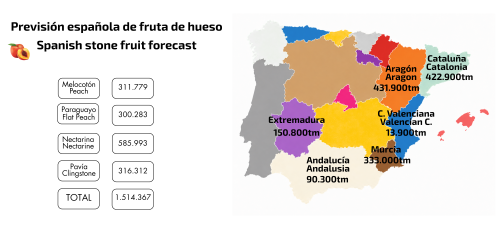
The 2026 campaign is also expected to show positive growth. Total production of peaches, nectarines, flat peaches and clingstone peaches could reach 1,514,367 tonnes, representing a 6% increase over 2025 and 14% above the recent average.
This includes nearly 1.2 million tonnes of peaches, nectarines and flat peaches, as well as approximately 316,000 tonnes of clingstone peaches.
The 2025 season had already been relatively positive, benefiting from the end of the drought that had particularly affected the Ebro Valley, resulting in more stable production and solid demand. Nevertheless, some areas experienced hailstorms and heavy rainfall.
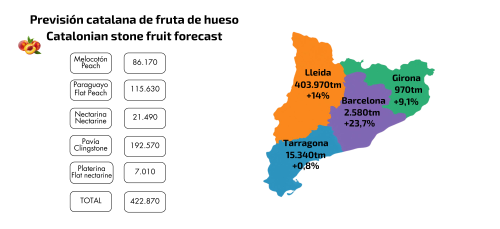
For 2026, conditions are generally favourable, with adequate winter chill accumulation and improved water reserves, although uncertainties remain in regions such as Catalonia and Aragón, while Extremadura is expected to experience lower production due to fruit-set issues.
Current trends point towards a reduction in cultivated area, accompanied by greater technification, varietal renewal, climate-change adaptation and an increasing focus on quality and market requirements.