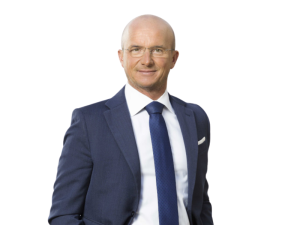






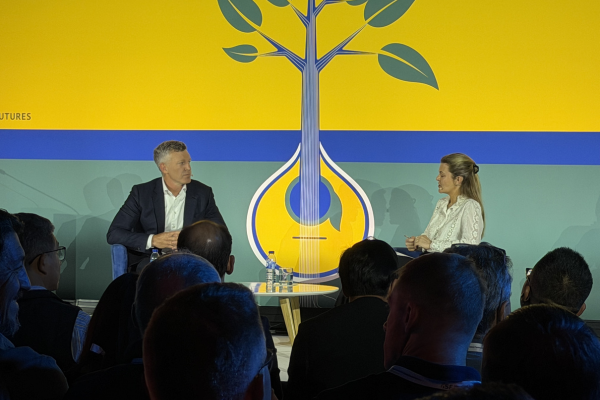
Jeff Rowe, Chief Executive Officer of Syngenta Group, was one of the standout speakers at the 2026 ISF World Seed Congress in Lisbon, taking part in a Fireside Chat where he reviewed the main drivers of change reshaping the global agricultural sector. Addressing an audience of seed industry professionals, Rowe presented a vision that combines technology, sustainability and a direct appeal to the European Commission: “Trust science.”
A historic pipeline
The executive highlighted the company’s pipeline as one of the strongest in its recent history. Among the innovations, he emphasised the launch of Xterra, its first hybrid wheat for the European market, together with three new crop protection active ingredients and advances in both vegetable and field crop seeds.
“We have never had launches of this magnitude across major products at the same time,” he stated.
AI embedded in every product
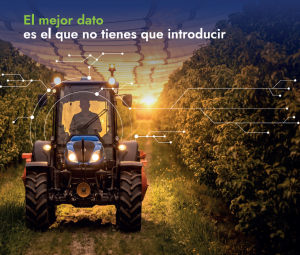
Artificial intelligence was at the centre of much of the discussion. Rowe explained that every new product developed by the company already incorporates the impact of AI at some stage of development and revealed that the technology is expected to reduce R&D timelines and costs by around 30%.
Syngenta currently invests close to $2 billion annually in research and development.
“This is not something that will happen in ten years’ time. It is already happening,” he stressed.
In his view, the future of agriculture will resemble personalised medicine: each field will generate vast amounts of data capable of guiding agronomic decisions at a highly granular level, potentially “levelling the playing field” between large-scale operations and smaller growers without access to high-quality technical advice.
Chemistry and biologicals: allies, not rivals
Another topic addressed during the discussion was the perceived dichotomy between synthetic chemistry and biological solutions. Rowe was unequivocal:
“One is not good and the other bad. Relying solely on biologicals would be a recipe for disaster.”
The company plans to launch 20 new active substances over the next decade and is working on combining both approaches.
“The results we are seeing from that combination are truly exciting.”
More investment in Iberia
Regarding the strategic importance of the Iberian Peninsula, the CEO stated that Iberia hosts “one of the most diverse product pipelines in the world”, covering crop protection, biologicals, horticulture and field crops led by sunflower.
“We have been here for a long time and will remain highly committed to this part of the world.”
Rowe explicitly linked future investment decisions to the regulatory framework, stating that if European legislation on genome editing progresses with greater clarity, Syngenta will increase its commitment to Iberia and Europe as a whole.
European regulation, the pending challenge
The CEO of Syngenta Group admitted that he has “lost many hopes regarding European regulatory processes” for new genomic techniques, although he remains cautiously optimistic about the possibility of progress in June.
“If regulation is clear and predictable, genome editing will drive more investment and European farmers, who have gone years without access to certain innovations, will begin to see real benefits.”
RELATED NEWS: Genome editing and global trade take centre stage at the World Seed Congress
The executive also highlighted that the Iberian region, with its diversity of crops and strong export orientation, has much to gain from a stable regulatory framework.
He summarised his position by repeating a message directed at Brussels:
“Trust science.”