








“We don’t know what will happen, but it could be an interesting year,” he summarises. Market behaviour in the coming months will depend on multiple factors: weather developments, consumption trends and the evolution of stored potatoes.
Following a previous campaign marked by oversupply, the sector is now entering a new cycle in which the balance between supply and demand will be decisive.
The early potato campaign, particularly in areas such as Cartagena, has been affected by wind episodes recorded at the end of January and beginning of February, with gusts exceeding 70 km/h. These conditions have directly impacted crop development, causing a significant reduction in tuber size.
The impact does not translate into a total loss of production, but rather into smaller-sized product, especially in the first harvests. However, this situation is not expected to persist throughout the campaign. As the season progresses, particularly from May onwards, sizes are expected to normalise, with production levels more in line with what is typical for this time of year.
RELATED NEWS: Fresh potato consumption falls by more than 4.5 kg over 10 years
This staggered production between regions such as Cartagena and Seville could play in favour of the market. Differences in production calendars help to avoid excessive overlap and facilitate greater supply stability, a factor the sector considers positive in a year of difficult forecasting.
Nevertheless, the market remains influenced by the volume of stored potatoes still available in Europe, with competitive prices limiting margins for new potatoes in the early weeks of the campaign. This factor will require adjustments in pricing and commercial strategies, particularly in a context where consumers remain price-sensitive.
From Patatas Córdoba, this situation is viewed pragmatically. The coexistence of new and stored potatoes responds to different consumer needs, and the market will ultimately regulate itself based on available supply.
Company expansion
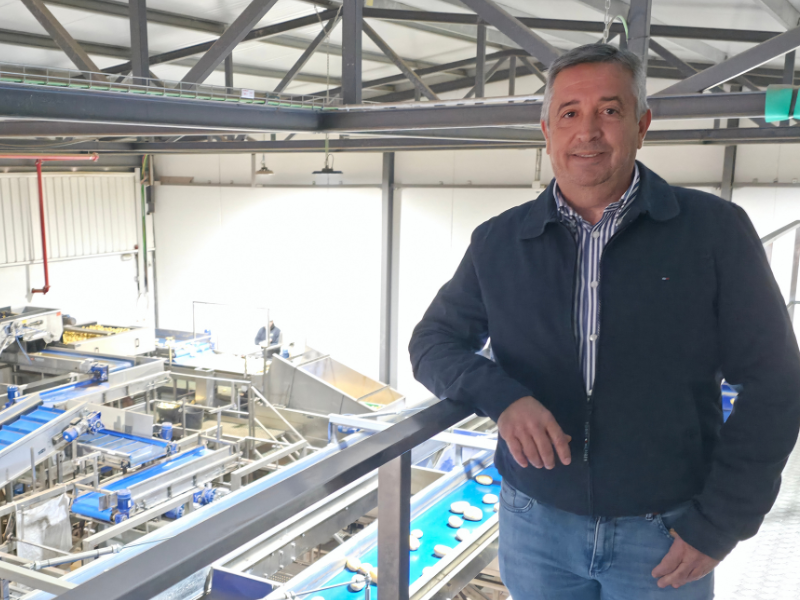
Beyond the production context, the company has taken a step forward in recent years in terms of its structure. The expansion of its facilities and the incorporation of new lines have enabled Patatas Córdoba to increase its packing capacity and improve operations, adapting to the demands of modern retail.
The company currently operates on a 16,000 m² site, with a 5,500 m³ packing facility and four storage chambers.
This industrial reinforcement places the company in a stronger position to manage complex campaigns such as the current one, where flexibility and adaptability are key. The company combines this structure with a model that integrates all types of packaging solutions for both modern retail and the Horeca channel, allowing it to respond quickly to market demands.
Everything suggests that the impact of wind on tuber size, the volume of potatoes available in Europe and consumption trends will shape the course of the coming months. However, in this uncertain scenario, “difficult campaigns can also become opportunities,” the executive concludes.