










Spanish companies should prepare for a scenario of greater uncertainty and higher costs. The Eurozone is facing a new period of economic instability.
Isabel Schnabel, member of the Executive Board of the European Central Bank (ECB), has warned of the resurgence of disruptions in global supply chains and the spread of a new inflationary wave across the continent. The warning highlights the fragility of the international economy and its direct implications for Spanish companies, particularly those involved in foreign trade.
According to Schnabel, if the current energy shock broadens or persists, the ECB could be forced to implement further interest rate hikes, adding pressure to financing costs for businesses. This outlook, confirmed by ECB surveys of Eurozone companies, suggests that many firms already expect inflation to rise again if the current geopolitical situation, particularly the war in Ukraine, continues for several months.
Impact on global supply chains
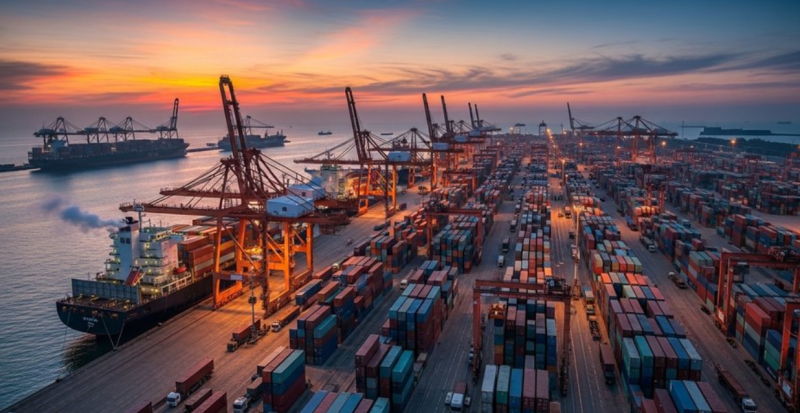
Signs of renewed weakness in supply chains are a warning signal for Spanish foreign trade. After a period of relative stabilisation, the return of these problems could mean delivery delays, higher transport costs and greater difficulty accessing certain essential components or raw materials.
Sectors such as automotive, electronics and even the agri-food industry, which are highly dependent on global inputs, would be among the first to feel the impact.
“The resurgence of logistical disruptions directly translates into lower operational efficiency and higher costs for our exporting and importing companies,” explained an analyst consulted by Empresa Exterior. “Companies must review their procurement strategies, consider alternative suppliers and, where possible, seek greater geographical proximity to reduce vulnerability.”
Inflation spreads across the Eurozone
Concern over inflation is intensifying. Schnabel’s remarks and ECB surveys suggest that the energy shock, far from having fully eased, could be reigniting price pressures across the Eurozone.
This implies:
- Higher production costs: rising energy and raw material prices are passed on to production processes.
- Reduced margins: companies often absorb part of these costs to avoid losing competitiveness, reducing profitability.
- Impact on consumption: a general increase in prices reduces consumers’ purchasing power, affecting both domestic and external demand.
- Wage pressure: this could trigger a wage-price spiral, making long-term inflation control more difficult.
How does this affect Spanish companies?
For Spain, whose economy has a strong export orientation and a vital tourism sector, the ECB’s warnings are particularly significant. Spanish companies engaged in foreign trade face a complex scenario that requires agility and rigorous strategic planning.
“Spanish exporters must carefully analyse the composition of their costs, especially those related to energy and transport,” said Elena García, director of internationalisation at a consultancy firm in Madrid. “Now is the time to strengthen relationships with key suppliers and explore market diversification to mitigate risks. Supply chain resilience is no longer an extra; it is an urgent necessity.”
RELATED NEWS: Closure of Hormuz sends global fertiliser trade into sharp decline
Adaptability will be key. Companies that have already invested in operational digitalisation, supply chain visibility and geopolitical risk analysis will be better positioned to face this new cycle of uncertainty.
In addition, the possibility of further interest rate hikes by the ECB would increase financing costs, making investment and international expansion decisions more complex.